Immersed or above-ground cover: which choice suits your swimming pool project?
Written by:
Modified on:
Reading time:
Article outline
- Submerged or above-ground cover: what really changes?
- Do the two shutters protect your children equally well?
- How much does an above-ground or submerged pool cover cost in 2026?
- Location, aesthetics, maintenance: what each shutter changes in daily life
- New or existing pool: which cover to choose for your project?
- Immersed or above-ground shutter: our approach at Aboral
“Take the submerged one, it’s safer.” This recommendation, frequently made when providing a quote, is nevertheless based on a persistent misunderstanding. A swimming pool roller shutter secures the pool by complying with a precise standard, not because of its location.
The choice between an immersed or above-ground shutter mainly depends on three criteria: your budget, the available space, and the progress of your project, depending on whether the pool is still to be built or is already installed.
On a shell pool, the submerged shutter housing is part of the structure: it must therefore be chosen at the time of ordering. The shutter itself can be purchased later, which allows for spreading out the investment.
Functionality, safety, cost, daily constraints: each criterion is detailed below, followed by a decision matrix.
In summary:
- Whether above-ground or submerged, a pool cover compliant with the NF P90-308 standard offers equivalent safety.
- Count on approximately €2,500 to €7,000 for an above-ground installation, compared to €6,000 to €15,000 for an in-ground one.
- For a pool, the submerged cover is chosen at the order stage, while the above-ground cover is the only option for an existing pool.
Submerged or above-ground cover: what really changes?
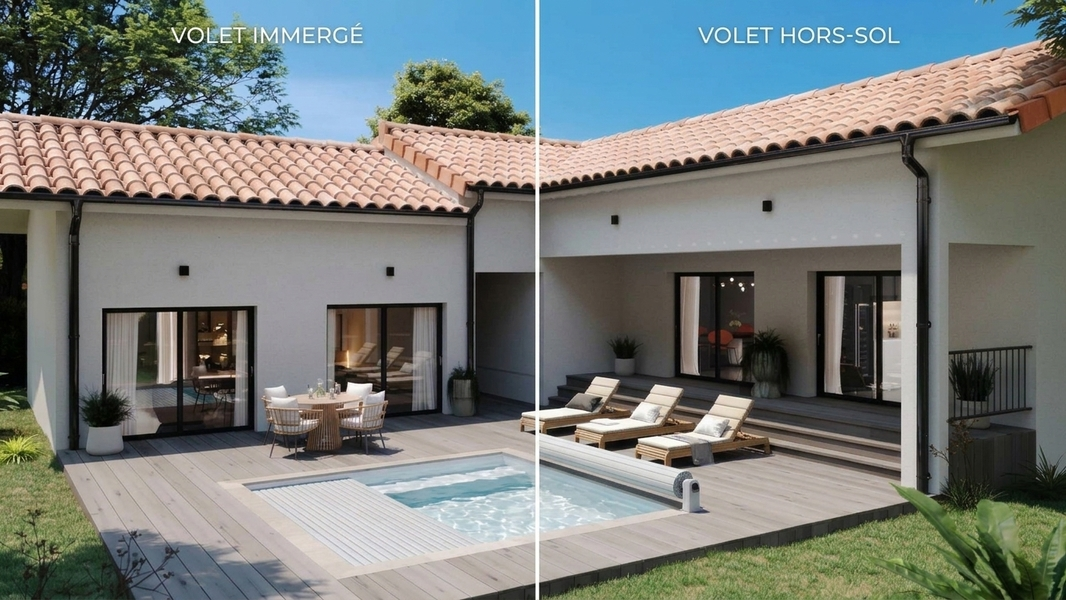
The difference is essentially due to the location of the winding axis, that motorized tube which winds the shutter. The shutter, a set of articulated slats floating on the surface, remains perfectly identical in both configurations.
- The above-ground shutter: the axis, placed on feet or hidden in a bench, is installed at the edge of the basin, on a new or existing swimming pool.
- The submerged cover: the shaft is housed at the bottom of the pool, in a box closed by a grating, a perforated and removable floor.
- The submerged slatted cover under the beach: the housing is integrated under the pool's submerged beach and closed by porcelain stoneware gratings, which makes the mechanism invisible
The location of the motor, installed in a dry pit or integrated into the shaft, primarily determines the ease of maintenance. The advantages of an immersed shutter therefore mainly stem from its aesthetic discretion.
Common to both technologies, the choice of slats generally favors PVC slats, 72 mm wide. They are available in white, sand, and several shades of gray. The solar polycarbonate slats, 60 mm wide, capture radiation and naturally heat the water.
Keep in mind: the trade-off concerns the location of the axis and the motorization, never the apron.
Do the two shutters protect your children equally well?
Yes, provided that this equipment is compliant with the NF P90-308 standard. An NF standard constitutes a technical reference framework, published by AFNOR, that precisely defines the tests a product must pass. This one concerns safety covers, without distinguishing between above-ground and submerged shutters.
Since the law of January 3, 2003, private in-ground swimming pools have required a standardized safety device. This obligation has applied to new pools since January 1, 2004, and recognizes four categories of standardized equipment. Barriers (NF P90-306), alarms (NF P90-307), covers (NF P90-308), and shelters (NF P90-309) constitute these categories.
The automatic pool cover naturally belongs to the family of safety covers. An installation lacking such a device is subject to a fine of up to €45,000.
The standard requires that a cover must support 100 kg and withstand handling by a young child. Concretely, the shutter must be fully closed and then locked with safety fasteners. When partially open, it offers strictly no protection.
This requirement entails systematically closing the cover after each swim, whereas a barrier provides permanent protection. The choice of safety device therefore also depends on your family habits.
Key takeaway: security relies on compliance and locking, never on the location of the mechanism.
How much does an above-ground or submerged pool cover cost in 2026?
For an 8 × 4 m pool, an above-ground cover costs about €2,500 to €7,000 installed. An immersed cover generally represents €6,000 to €15,000, depending on dimensions and motorization.
| Criterion | Above bare ground | Above-ground bench | Immersed | Submerged under beach |
|---|---|---|---|---|
| Prix posé (8 × 4 m) | 2 500 – 6 000 € | 3 500 – 7 000 € | 6 000 – 15 000 € | 7000 – 16 000 € |
| Can it be added later? | Yes, at any time | Yes, at any time | Yes, if the trunk is specified at the time of order | Yes, if the trunk is specified at the time of order |
| Congestion | By the pond | By the pond | 50 cm à 1 m de bassin | None |
| Open shutter visibility | Visible | Dressed | Quasi-Invisible | Invisible |
| Maintenance access | Direct | Direct | Through the grating | Through the grating |
Key takeaway: the price difference pays for the aesthetics and the freed-up space, with no additional security.
When it comes to a shell pool, you are actually comparing two different shells, respectively equipped with or lacking a built-in cover housing. This overall difference must be viewed in relation to the price of a shell pool as a whole.
Beyond the initial investment, three items gradually weigh on the budget:
- Polycarbonate slats: they entail an additional cost of approximately €800 to €2,000
- Blade replacement: it takes place after 8 to 15 years, for €1,500 to €3,000.
- Engine replacement: it represents approximately €500 to €2,000 in the event of a failure.
Key takeaway: evaluate the total cost of ownership over about ten years, not just the acquisition.
Location, aesthetics, maintenance: what each shutter changes in daily life
The above-ground shutter takes up space at the edge of the pool, but makes maintenance easier.
At the edge or in the pool: where do you lose space?
An above-ground pool cover forms a casing about 60 to 80 cm high. Discreet on wide pool surrounds, it obstructs the view and passage on narrow ones.
Let us take the example of a 6 × 3 m pool bordered by a 1.50 m deck. With an above-ground shutter, the casing takes up a significant portion of this deck. With a submerged shutter, the deck remains clear, but the swimming length decreases by approximately fifty centimeters.
Maintenance, breakdowns and troubleshooting
The submerged housing is cleaned once or twice a year, after lifting the grating. Maintained in this way, a submerged pool cover generally exceeds ten years of service. A high-pressure cleaner can be used, provided that you never exceed 80 bars. The guide dedicated to cleaning the submerged cover housing details the method.
On an above-ground shutter, exposure to ultraviolet rays can accelerate the yellowing of the PVC. In the event of a breakdown, however, repair remains straightforward, unlike with an immersed shutter. The latter depends entirely on the accessibility of the motor, hence the value of a disengageable motor, which can be operated manually.
To remember: opt for above-ground with a spacious deck, or submerged when every square meter counts.
New or existing pool: which cover to choose for your project?
Before ordering a shell, both options remain feasible, but the installed pool generally dictates an above-ground setup. For a new shell pool, since the housing is molded into the structure, selecting a model without housing permanently excludes an immersed cover. The immersed shutter housing is considered at the same time as the pool dimensions.
On an existing masonry pool, adding a housing requires major work. On a one-piece shell, the operation remains unthinkable, whereas an above-ground shutter is generally installed in a day.
| Your situation | Recommended section | Justification |
|---|---|---|
| New hull, narrow beach | Submerged or underwater | Entirely clear beach |
| New case, controlled budget | Shell without casing, then above-ground | Staggered investment |
| Existing swimming pool | Above ground, bare or with a bench | No chest to create |
| Two-step project | Barrier or alarm, then above-ground | Safety from the moment of filling |
Key takeaway: the progress of the project often eliminates an option even before the budget question.
The roller shutter also requires a rectangular shape or right angles. A corner staircase requires a specific cutting of the apron, charged at approximately €300 to €800.
Keep in mind: determine the type of shutter simultaneously with the pool model, never after.
Immersed or above-ground shutter: our approach at Aboral
Regardless of the manufacturer, the layout study determines the swimming length, the beach width, and the desired level of discretion. At Aboral, we deliberately offer both types of covers. Our submerged slatted cover range includes models from 3.90 to 10.80 m.
The Fetuna 7 Plus is one of them, with 6.90 × 3.00 m and 22 m³. It also exists without a pool cover housing, under the name Fidji 6, to accommodate an above-ground shutter. Our under-deck range includes models from 7.50 to 8.50 m, with the housing clad in porcelain stoneware.
We manufacture the Cover 100 and Cover 300 Light above-ground pool covers in France, featuring a bench and LED lighting. The Deck 500 immersed cover completes this French range.
All comply with the NF P90-308 standard and are guaranteed for 3 years. The shell benefits from a 20-year warranty on the structure and watertightness. The gelcoat, the smooth coating that forms the inner surface of the pool, is guaranteed for 10 years.
This choice cannot be settled with an accessory purchased afterwards, but rather at the moment of designing the pool.
Our resellers can survey your land and provide a precise quote for both options: let's discuss it together, depending on the progress of your project.
Share this article

Yes, a solar shutter is possible both above-ground and submerged. The photovoltaic panel is generally housed on the bench for above-ground models, and on the grating or the coping for submerged ones.
No, a swimming pool cover does not need to be declared to the town hall. This equipment does not effectively create any additional floor area or footprint. Only the pool itself is subject to a prior declaration or permit.
Yes, you can winterize your pool with the shutter closed, although it does not replace a winter cover. The shutter does, however, limit the accumulation of leaves and winter evaporation.
No, a pool cover does not fit every pool shape. The rolling of the slats requires a rectangular basin, automatically excluding free-form or irregular shapes. A corner staircase remains compatible thanks to a custom cut of the cover.
If the shutter motor breaks down, contact your installer promptly. In the meantime, increase supervision of access to the pool.
You may be asking yourself these questions?
On the same topic
Your fiberglass pool project is waiting for you!
Configure your shell pool in just a few clicks or find your nearest Aboral distributor for personalized support from start to finish.