Spending time in your pool with family or friends is synonymous with moments of relaxation, pleasure and sharing. Unfortunately, the swimming season season often accompanied by risks ofaccidents and drowning. A risk that must be avoided as much as possible.
Fortunately, there aresafety systems(pool enclosure,barrier,automatic cover, etc.) designed for theprotection of your pool. But while the purchase, installation, and maintenance of a pool already represent a significant financial investment, adding a safety device comes at a certain price and can lead to additional expenses…
In the following lines, we invite you to discover how to secure a swimming pool with one of the most effective safety devices, taking your budget into account.
Why secure your swimming pool?
What the law says
This summer, in 2023, France unfortunately recorded 598 cases ofdrowning. An alarming figure, which most often affects young children.
Faced with this reality, theprotection of one's swimming poolappears to be an obvious measure. And for good reason, besides the concern of protecting loved ones, the installation of asecurity systemhas become a legal obligation.
Indeed, to combat the risks of drowning, laws have been put in place, notably the“swimming pool safety” law of 2006, which requires owners of private, in-ground or semi-in-ground swimming pools tosecure their pool. This legislation has proven its effectiveness, as since its creation, the number of drownings has decreased despite the increase in the number of private swimming pools.
While this law does not apply to owners of above-ground pools, this does not mean that they should neglect safety. It is strongly recommended to secure your pool, whatever it may be, to prevent the risk of drowning accidents.
On the market, manysecurity systemsare available for homeowners, allowing them to choose the one that best suits their needs.
The different devices for securing your swimming pool
There are various pieces of equipment that ensure thesafety of your pool. Devices that are more or less bulky, more or less expensive, and more or less effective.
A choice that may therefore be more or less obvious depending on your specific needs.
Among the various security devices available today, we find the following:
– Poolenclosures;
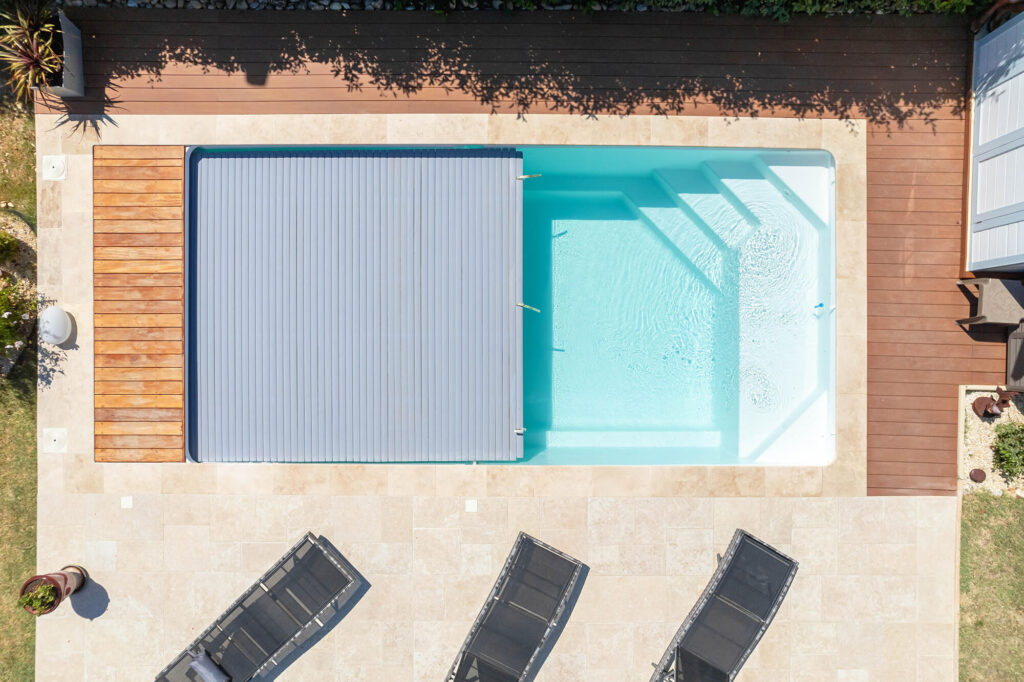
– Thesafety cover(with thepool shutteror theslatted pool cover) ;
– Thepool fenceorpool barrier;
- L'pool alarm (submerged or perimeter)
Each of these devices has its own advantages and disadvantages. Some, in addition to ensuring safety, can extend the swimming season to reducing maintenance efforts and impacting the water temperature; this is the case with thepool enclosure for example. Others, on the other hand, are more discreet and do not alter the aesthetics of your garden, as is the case with the pool cover (pool shutter or tarpaulin).
You will have understood; the choice will depend on several criteria, such as the size and layout of yourpool, the profile of the pool users (children, older children or adults) but also your budget.
The pool alarm, the most economical device for securing your pool
One alarm, two possibilities
The pool alarm is undoubtedly the most economical option. Compliant with the NF P90-307 standard, the pool alarm is particularly well suited to tight budgets. It includes a set of sensors that monitor the pool, triggering an audible noise as soon as an intrusion is detected.
Currently, there are two types of alarms on the market:submerged alarmsandperimeter (or peripheral) alarms.
It is important to choose your alarm carefully, depending on your pool and your needs:
– The submerged pool alarmuses one or more probes to detect movement in the water. The advantage of this device is that it remains invisible from the outside and does not alter the appearance of your pool or garden. It is also the least expensive device among approved safety devices.
– The perimeter alarm, unlike thesubmerged alarm, can detect movement upstream, thanks to sensors placed around the pool. This makes it a more preventive option, as it alerts you to movement around thepool, within a more or less wide, pre-defined perimeter.
How to choose the right pool alarm?
Once you have shortlisted the model you want, you need to make sure that it complies with current standards. In theory, non-approved alarms should not be marketed, but it is important to check that the chosen model is indeed approved and complies with current standards.
To comply with the regulations, several points deserve your attention:
– The sound power of the pool alarm must be at least 100 decibels at a distance of 1 meter;
– It must mention theNF P90-307 standard;
– It must be equipped with an automatic reactivation system;
– It must be compatible with the type ofpoolyou have;
– It is recommended to choose a reference brand, recognized for its reliability in terms of alarms.
Unlike bar covers or other types of coversthe Eure (27)pool alarm is very simple and quick to set up. Protecting your pool is done in no time, simply by programming the alarm according to your criteria and placing it in the water, if it is a submerged alarm
It is best to choose a quality, reliable and durable product that can withstand the vagaries of the weather. However, it is important to check your device at the beginning of each swimming season toensure that it is working properly. All this in order to avoid drowning accidents.
Beyond the safety devices, it is important to remember that none of these devices exempt the people present around the pool to stay vigilantes. The surveillance is paramount, especially when children are present around the pool!
Configure your pool online Back to all news