Which pool liners should I choose?
Written by:
Modified on:
Reading time:
Article outline
- What is the bottom of a prefabricated pool, and why is this choice so important?
- Flat bottom or sloped bottom: What practical differences does this make for your use?
- What bottom depth should you choose based on your usage profile?
- Flat bottom or sloped bottom: which one is really easier to maintain?
- How does Aboral Piscines help you choose the right pool liner for your project?
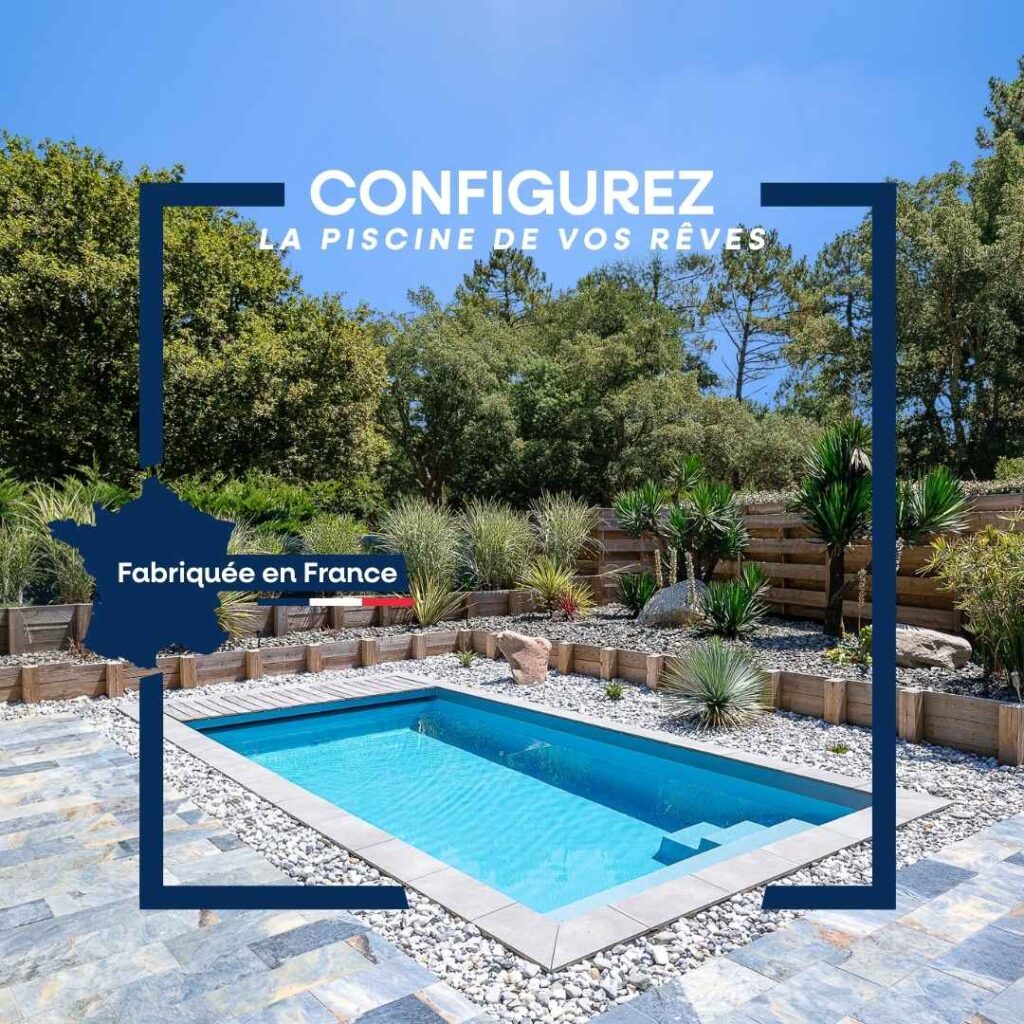
You have the plan, the lot, and maybe even an idea of the shape of your pool. But when your pool contractor asks, “Flat bottom or sloped bottom?” you start to have doubts. That’s normal: this decision is rarely explained clearly, even though it will affect your swimming comfort for the next 20 or 30 years.
With a fiberglass pool, the bottom is integrated into the structure during manufacturing: it cannot be modified after installation.
The right choice depends on who uses your pool, your lifestyle, and your budget. This guide provides everything you need to make an informed decision.
In summary:
- The pool floor is integrated into the shell during manufacturing: it cannot be modified after installation, which makes it a key decision that must be made at the project’s design stage.
- The two main options are the flat bottom (versatile, easy to maintain) and the sloped bottom (gradual, suitable for mixed-age families); premium alternatives such as the movable bottom are available for specific projects.
- The ideal depth depends on the users' profiles: a depth of between 1.20 m and 1.40 m meets the needs of the vast majority of families.
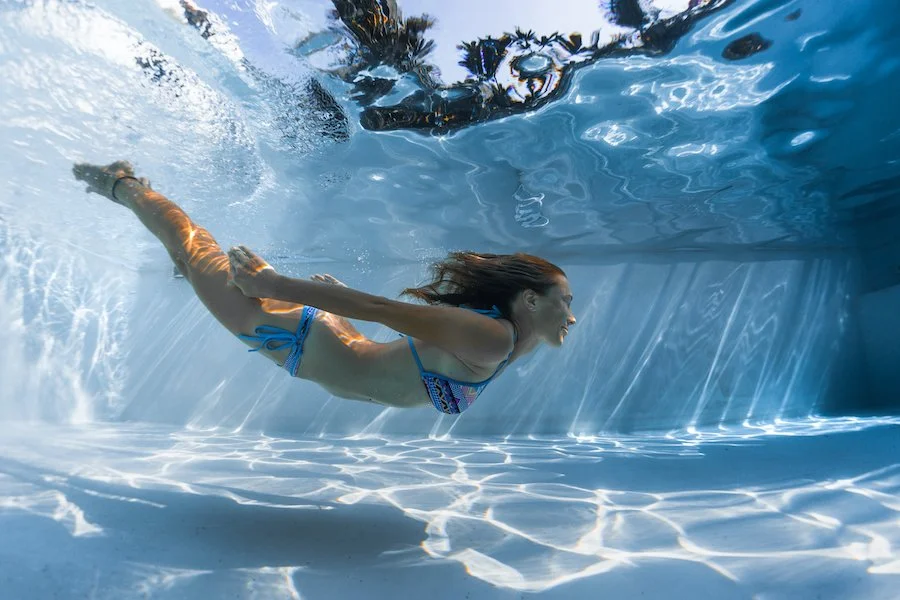
What is the bottom of a prefabricated pool, and why is this choice so important?
In a fiberglass pool, the term “bottom” refers to the interior floor of the pool, that is, the horizontal surface on which swimmers stand. This floor can be flat, gradually sloped, or feature areas at different levels, depending on the chosen configuration.
What distinguishes a prefabricated pool from a concrete-built poolis precisely the irreversibility of this choice: the shell is manufactured in a factory in a single piece, through the layering of polyester. The shape of the bottom is an integral part of the structure, just like the overall shape of the pool or its dimensions. This is why the bottom cannot be chosen in isolation: it is part of an overall choice of pool model that must be considered from the outset, taking into account the actual use of the pool and your household’s profile.
In practice, the pool liner affects four key aspects of your swimming experience:
- Safety (slip hazard, accessibility for children and seniors),
- Comfortable swimming (swimming, games, water aerobics),
- Ease of maintenance (robot movement, debris buildup),
- and finally, accessibility for people with disabilities in certain specific cases.
These are all factors you should consider as early as your first meeting with your pool contractor.
Flat bottom or sloped bottom: What practical differences does this make for your use?
Flat bottom or sloped bottom? Both options have their own advantages, and the right choice depends primarily on the composition of your household and how you plan to use the pond.
The flat bottom: versatility and ease of maintenance
A flat-bottom pool, as the name suggests, has a uniform depth across the entire surface of the pool. This depth typically ranges from 1.20 m to 1.50 m for standard family models. It is the most common configuration, and for good reason. It is suitable for recreational swimming, water games, aqua aerobics, and gentle swimming.
Cleaning is made as easy as possible: the automatic robots move across a perfectly even surface without having to navigate changes in slope. Debris (leaves, insects, sand) does not accumulate in any particular area.
For families with children of different ages, a pool with a depth of 1.30 meters is often the best compromise.
The sloped bottom: a natural progression, ideal for blended families
The sloped bottom features a gradual incline from a shallow area (typically around 0.90 m) to a deeper adult area (1.40 m to 1.80 m, depending on the model).
This layout recreates a more natural swimming experience, similar to walking into the ocean. It is particularly popular with families with young children, as the shallow area provides a safe play space on the “beach” side. However, this layout has a practical drawback: debris tends to drift toward the deepest area due to water circulation. Manual vacuuming may be necessary in addition to the automatic robot.
Here is a comparison chart to help you quickly determine which configuration best suits your needs:
| Criterion | Flat bottom | Sloped bottom |
| Depth | Uniform (1.20–1.50 m) | Progressive (0.90–1.80 m) |
| Primary use | Family / Leisure / Relaxation | Coed / Leisure Swimming |
| Robot Maintenance | Optimal, linear path | Well, there is a slight concentration of deposits in the deep zone |
| Comfort for children | Provides safety across the entire surface | A shallow area designated for children |
| Diving | Not recommended | Not recommended unless the water is very deep (≥ 1.80 m) |
| Ease of maintenance | Very easy | Slightly more complex |
What bottom depth should you choose based on your usage profile?
Reference depths based on the swimming profile
Choosing an inappropriate depth (too shallow for adult swimmers, or too deep for a family with young children) is one of the most common mistakes in pool projects. And just like with the choice of pool bottom, it’s impossible to correct once the shell is installed.
The following table summarizes the recommendations typically followed by professionals in the prefabricated pool industry, based on different usage profiles:
| User Profile | Recommended depth | Point to watch out for |
| Young children | 0.80–1.00 m | Mandatory supervision; safety barrier required |
| Blended family | 1.20–1.40 m | A flat or slightly sloped surface is recommended |
| Adult swimmers | 1.40–1.60 m | Flat bottom for a swimming lane |
| Diving | ≥ 1.80 m (regulated) | This should be addressed as early as the design phase |
What do the regulations say about the minimum depth?
Unlike public swimming pools, private pools are not subject to national regulations setting a minimum legal depth. However, diving requires strict safety precautions: industry experts recommend a minimum depth of 1.80 m to 2.00 m below the landing area.
If this use is planned, it must be specified as early as the design phase. Legal requirements regarding pool safety (fences, alarms, covers) apply to all configurations, regardless of the chosen depth.
Flat bottom or sloped bottom: which one is really easier to maintain?
Maintaining a pool requires a significant daily investment of time and money. And the shape of the pool bottom directly affects how often and how easily this maintenance can be performed. This is an aspect that many pool owners underestimate when choosing their pool.
How the surface affects dirt buildup
On a flat surface, automatic cleaning robots move in a straight line and cover the entire area evenly. Debris (leaves, insects, dust) is distributed evenly and is easily vacuumed up as the robot passes over it.
On a sloped surface, particles suspended in the water naturally tend to slide toward the deepest area due to gravity and water circulation. The robot can reach this area, but it is often recommended to follow up with manual vacuuming, especially after a period of strong sunlight or wind.
The role of gelcoat in ease of cleaning
Regardless of the type of pool base, the quality of the interior finish plays a major role in how easy the pool is to maintain. The polyester gelcoat of a high-quality prefabricated pool provides a non-porous, smooth, and waterproof surface, which significantly reduces algae growth and mineral buildup.
At Aboral Piscines, the Sparkle finishes (available on pools in the Tailor Made line) incorporate reflective particles that enhance this effect while providing a premium visual finish. The Iconic Grey, Pacific Blue, Silver Grey, and Mineral Sand colors in this line do not compromise on durability or ease of maintenance.
How does Aboral Piscines help you choose the right pool liner for your project?
At Aboral Piscines, every project begins with a site visit to assess the layout of the property, the soil conditions, the orientation of the future pool, and the intended uses. Based on this information, our consultants propose a selection of suitable models (with corresponding pool liner options), along with a visual rendering and a transparent cost estimate.
The range includes models with flat bottoms, sloped bottoms, and custom configurations for projects requiring a custom approach. For over 30 years, this comprehensive support from start to finish has helped prevent design errors that would be difficult to correct after installation.
Choosing the floor of your prefabricated pool means defining the swimming experience you’ll enjoy for years to come: your children’s safety, the ease of your weekly maintenance, and the comfort of your swim. And since this is a permanent decision, it deserves to be made with the same care as the pool size or its placement in the garden.
Building a pool is, above all, a lifelong project that represents a long-term commitment to your property. The good news is that the options available today can accommodate virtually any family situation—from the simplest to the most specific—provided you discuss them in advance with the right professional.
The experts at Aboral Piscines are here to help you evaluate your project and recommend the pool design that best suits your home, your property, and your budget.
Share this article

You may be asking yourself these questions?
No, the bottom is integrated into the hull’s structure during manufacturing. Any modification would require replacing the entire hull.
Pools with a depth between 1.20 m and 1.40 m meet the needs of the vast majority of families. A gently sloping bottom (0.90 m on the children’s side, 1.40 m on the adults’ side) is often the best compromise for a mixed-age family.
Yes, cleaning robots work best on a flat surface. A sloped bottom causes debris to accumulate in the deeper areas, which may require additional manual cleaning.
Regulations for private swimming pools do not specify a legal minimum depth, but industry experts recommend a minimum depth of 1.80 m to 2.00 m at the shallow end.
For standard configurations (flat or sloped bottom), no: the bottom is included in the price of the hull.
On the same topic
Your fiberglass pool project is waiting for you!
Configure your shell pool in just a few clicks or find your nearest Aboral distributor for personalized support from start to finish.