The winterizing of your pool is approaching, are you ready?
Written by:
Modified on:
Reading time:
Article outline
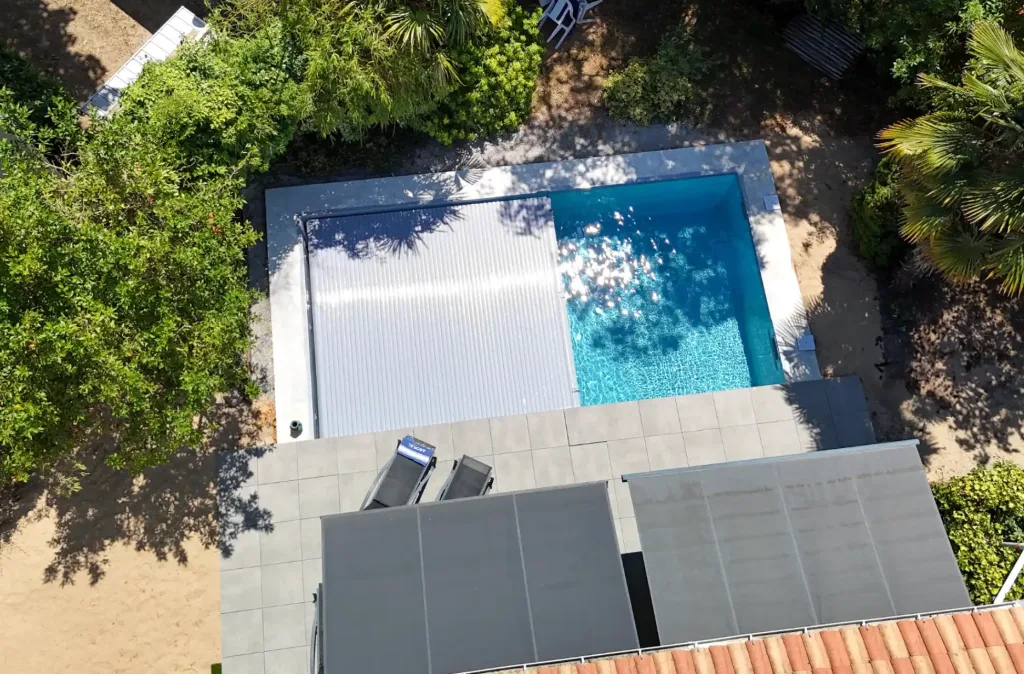
Important information: putting on the cover and stopping the pump is not enough if you want to properly winterize your pool. A successful pool winterization depends less on the cover placed on the pool than on the actions taken beforehand, on the water, the level, and the pipes.
Concretely, a pool winterized too quickly or without antifreeze protection exposes you to repairs in the spring: cracked filter, burst pipes, green water as soon as the weather is nice. The cost of these incidents far exceeds that of proper preparation in the fall.
This page details how to winterize a swimming pool step by step: the right time to start, the choice between passive and active winterization, water preparation, frost protection, and equipment to remove before the first cold spells.
In summary:
- Wintering begins when the water reaches 12°C, not before (risk of green water) and not after (risk of frost).
- Passive winterization completely stops filtration, whereas active winterization maintains it for 2 to 3 hours per day depending on the climate.
- Lowering the water level, protecting the pipes, and covering the pool prevent most of the damage observed in the spring.
When should you start winterizing your pool?
You can start winterizing your pool as soon as the water temperature reaches 12°C or drops below it. This threshold is not arbitrary: it is the point at which the micro-organisms responsible for green water stop developing actively.
Wintering too early, when the water temperature is above 12°C, leads to closing the pool in conditions favorable to algae and bacteria. The result in spring is cloudy water that needs urgent treatment before the first swim, with unnecessary consumption of shock chlorine and algaecide.
Conversely, waiting too long (when the water temperature drops below 10°C) exposes the installation to the risk of frost even before the procedure begins. A filter or pump still in water during the first freeze can crack.
The period varies depending on your region: generally between late October and December in France, earlier in areas with harsh winters, later on the coast. Remember the thermometer, not the calendar date, as the true trigger.
Passive or active wintering: which method to choose?
Two methods exist for winterizing an inground pool and the choice depends mainly on your climate.
Passive wintering consists of completely stopping the filtration system (including the sand filter). It is the most common method in regions with harsh winters, where the risk of frost lasts for several months. The hydraulic circuit is drained, the filter cleaned, and the water remains still until spring.
The active wintering, or semi-wintering, maintains reduced operation: the filtration runs 2 to 3 hours per day, during the coldest hours. This method is suitable for mild climates, where the risk of frost remains limited and facilitates the restart of your pool in the spring.
The wrong choice has a cost: unnecessary passive wintering in a temperate region immobilizes the installation for no reason, while active wintering in an area with frequent frost exposes the pump to a prolonged power outage during a cold snap.
| Criterion | Passive wintering | Active wintering |
| Principle | Complete shutdown of filtration | Filtration kept at idle |
| Filtration | None, system drained | 2 to 3 hours per day |
| Suitable climate | Harsh winters, frequent frost | Mild climate, occasional frost |
| Main risk | Water harder to catch in spring | Gel in case of prolonged power outage |
What to remember: your region's climate determines the method, not personal preference. For a deeper comparison, consult our article dedicated to active and passive overwintering.
Water cleaning and treatment before wintering: essential steps
Before closing your pool and to ensure the best recommissioning, the water and the pool must be in impeccable condition. This step directly determines the quality of the water you will find in the spring.
Clean the basin and the filter
Perform a thorough cleaning of the pool with the pool robot: the bottom, walls, waterline, and steps must be free of deposits before closing. A forgotten residue becomes a breeding ground for algae during the months of inactivity.
If you opt for passive wintering, the filter must also be thoroughly cleaned, with adescaling product suitable for your filter type. A scaled filter before complete shutdown loses efficiency as soon as it is restarted.
Perform a shock treatment and adjust the pH
Perform a shock treatment a few days before closing, then check that the pH is within the recommended range. Poorly balanced water at closing promotes algae growth, even at low temperatures. Therefore, use the right winterizing product to ensure good water quality upon reopening your pool.
This dual action, cleaning and treatment, remains the most reliable guarantee of clean water upon reopening.
Water level and pipe protection: how to prevent freezing?
The following steps concern passive wintering. In active wintering, filtration continues to run: the water level remains normal so that the skimmers function and the circuit is not drained.
When your pool is winterized, frost protection relies on a simple, often poorly executed step: lowering the water level to about 10 cm below the return jets. This margin prevents frozen water in the pipes from bursting them.
However, be aware: this does not mean completely emptying the pool. A completely emptied pool is subjected to ground pressure that it is not designed to withstand alone, which can deform its structure. For cases where a more significant draining is necessary, consult our guide on how to empty your shell pool before proceeding.
Once the level is adjusted, close the filter valve and carefully drain the pump, filter, and skimmer circuits: any stagnant water in these components can freeze and damage them. Then install the anti-freeze accessories in the skimmers and nozzles to absorb expansion in case of freezing despite everything.
The key takeaways: water level and draining the circuits are the two actions that most effectively prevent costly spring repairs.
What equipment to remove and how to protect your pool until spring?
Some equipment should not remain in place during winter. Remove the ladder and diving board, then store them away from frost and bad weather. Left outdoors, these items will deteriorate more quickly. In passive winterization, the filter pump is also removed and stored out of the frost; in active winterization, it remains in place.
Then pour a winterizing product into the pool, in different places for even distribution. It protects the water from bacteria, limescale, and algae throughout the shutdown period, whether it's active or passive winterizing.
Finish with the installation of a winter cover suitable for your pool, which prevents leaves, rain, and impurities from accumulating in the water. For a pool that is exposed or frequented by children or animals nearby, a four-season rigid cover provides additional strength. For other cases, our guide to choosing the right winter cover details the criteria according to your budget and usage.
What to remember: the winterizing product and the cover work together, one protects the water, the other protects the pool.
How Aboral Piscines designs ponds that facilitate overwintering
On this subject, the design of the pool counts as much as the chosen wintering method. A flat bottom limits the volume of water to be treated and facilitates cleaning before closing. A well-protected cover mechanism avoids unpleasant surprises related to frost on mechanical parts.
At Aboral Piscines, we design our polyester shells with these constraints in mind. Our flat-bottomed models reduce the volume of water to monitor during winter, and our sunken shutter box protects the mechanism from frost and bad weather, unlike a surface-exposed shutter. These choices, considered from the manufacturing stage in France, limit weak points during winterization.
Our network of local dealers can also check your installation before the first frosts, a service particularly useful if you are winterizing your pool for the first time.
How to winterize a pool is not resolved with an accessory bought afterwards, but by decisions made at the right time, often from the design of the pool. If you are preparing a project or wish to have your current installation checked, the team Aboral Piscines remains at your disposal to discuss it.
Share this article

You might be asking yourself these questions?
At 12°C or below, you can start winterizing. Below this threshold, the microorganisms responsible for green water stop developing actively. Winterizing earlier, with still lukewarm water, conversely exposes you to cloudy water as early as spring.
No. Lower the water level to about 10 cm below the return jets, without completely emptying the pool. A completely empty pool is subjected to ground pressure that it is not designed to withstand alone, which can deform its structure.
Count 2 to 3 hours per day, during the coldest hours. This method is suitable for regions with a mild climate, where the risk of frost remains limited and facilitates restarting in the spring.
Yes, but it is not recommended. Without a cover, leaves, dust, and rain accumulate in the water for several months, which complicates cleaning and increases the treatment products needed for reopening.
The main risk is the freezing of pipes, the pump, and the filter still containing water. A first frost on an unprepared installation can crack these components, leading to more expensive repairs than preparation done in time.
On the same topic
Pre-footer call to action
A compelling message to encourage contact or a quote request.