Which pool lining should you choose: liner, tile, or gelcoat?
Written by:
Modified on:
Reading time:
Article outline
- What is a swimming pool liner really used for?
- Which pool liner should you choose based on the pool type: shell, concrete, or panels?
- Liner, reinforced membrane, tiling, polyester or gelcoat: how much does it cost and how long does it last?
- How to choose the color and finish of your coating?
- Is it possible to change or renovate the lining of an existing swimming pool?
- How does Aboral treat the coating of a shell pool?
"The finish, we'll see about that at the end, it's mostly decoration." This reflex is common when comparing different quotes.
Yet it is an essential element: the pool liner is not just about appearance. It is the skin that ensures the watertightness of the basin: it holds the water, withstands treatment chemicals, and is touched during every swim. It also depends on the type of pool, because you cannot install just anything on any basin.
This choice therefore commits your budget and your maintenance for 20 years.
Here is a numerical comparison of the linings, followed by guidelines for choosing the color and renovating an existing pool.
In summary:
- The type of lining depends first on the structure: liner, reinforced membrane, tiling, polyester, render or paint on a concrete pool, or integrated gelcoat on a shell.
- The price per m² is not enough: a liner is replaced around 10-12 years, a laminated polyester lasts 20 to 25 years; therefore, all costs must be taken into account.
What is a swimming pool liner really used for?
A pool liner serves three functions: it ensures the watertightness of the pool, it determines comfort to the touch, and it gives the water its color. It is therefore not limited to aesthetics.
In terms of waterproofing, it retains water and is resistant to disinfection products. In terms of comfort, it is in constant contact with the feet and skin, hence the need for a smooth surface. This surface also limits the attachment of algae, which facilitates maintenance.
In an 8 m by 4 m pool with a depth of 1.50 m, the lining covers the bottom and the four walls, which is approximately 68 m². This is the surface most exposed to the sun, water, and chemical products.
Finally, it depends on the type of swimming pool: concrete, panel, wood, or shell pools do not accept the same liners. Our comparison wood pool or shell pool details these differences.
Key takeaway: the pool lining should be chosen at the same time as the pool itself, never after.
Which pool liner should you choose based on the pool type: shell, concrete, or panels?
The type of coating depends on the structure: a concrete or panel pool receives an on-site applied coating, whereas a polyester shell is delivered with its own, the gelcoat. The two cases are therefore not comparable on the same level.
Masonry or panel pool: a liner to install
On a concrete or panel pool, waterproofing is applied after construction: the installed liner ensures it throughout its lifespan.
There are six solutions: the liner, which is the easiest to install, the reinforced membrane (a PVC reinforced with a mesh, installed in welded strips), tiling, laminated polyester (layers of resin and fiberglass), plaster, and paint. Plaster and paint are reserved for concrete pools.
A professional installs them, and the quality of the installation determines the result. To compare these pools with the shell type, the shell pool or built pool page details the structural differences.
Shell pool: the gelcoat is already the lining
On a hull, the gelcoat is a colored polyester resin, applied first into the mold, then reinforced with layers of fiberglass and resin. It forms the smooth and watertight surface that you see.
It is neither a liner nor a tile. Adding a coating to a shell makes no sense, since it is already watertight. Non-porous, the gelcoat limits the accumulation of impurities and the need for treatment products. Its durability over time depends primarily on the quality of the resins used: this is what determines the lifespan of a polyester coating.
Key takeaway: for a concrete pool, you choose a liner to install; for a shell, you choose a gelcoat color.
Liner, reinforced membrane, tiling, polyester or gelcoat: how much does it cost and how long does it last?
For a concrete swimming pool, paint and liners are the least expensive coverings to purchase, but also the least durable: about 5 years for paint, 10 to 12 years for a liner. Tile and laminated polyester cost more per square meter and last much longer.
A price per m² should be read in conjunction with its lifespan: a floor covering replaced twice in 20 years costs more than it seems. Each type of covering also has its limits!
| Coating | Support | Price per m² (supply, excluding installation)* | Indicative lifespan | Point to watch out for |
|---|---|---|---|---|
| Simple eyeliner | Concrete, panels | 10-50 € | 10-12 years old | Does not tolerate water > 28 °C |
| Reinforced membrane | Concrete, panels | 40-100 € | 15-20 years old | Installed by a professional, in welded seams |
| Tiles, glass paste | Concrete | 30-90 € | About 50 years old | Joints to be redone every 10 to 15 years |
| Laminated polyester | Concrete, panels | 80-100 € | 20-25 years old | Installed by a professional |
| Plaster | Concrete | 30-40 € | About 15 years | Reserved for concrete pools |
| Painting | Concrete | About €20 | About 5 years | To be done regularly |
| Gelcoat (hull) | Polyester shell | Included in the price of the pool | On average 2 times more durable than a liner | Final color, to be chosen at the time of order |
If you are hesitating between a shell or liner pool, this comparison completes the picture. For a shell, there is no price per m² to compare: the gelcoat is included in the price of the pool, ranging from €15,000 to €35,000 installed. The breakdown of costs can be found in our article on the price of a shell pool.
Estimate my swimming pool project budget
How to choose the color and finish of your coating?
Choose the color based on the pool environment: coping stones, terrace, vegetation, and sunlight. The color of the lining gives the water its hue: blue provides a vivid, deep color, while gray or sand offers a more subtle look. Four guidelines steer the choice:
- Coping and terrace: match the color of the pool to that of the coping stones to avoid a clashing contrast or a washed-out effect.
- Sunlight: observe the garden at different times of the day, as the same shade reads differently in direct sunlight and in the shade.
- Reversibility: a liner can be replaced and change color on that occasion; the color of a gelcoat is permanent.
- Shutter: also match the color of the shutter slats to that of the pool. Closed for a large part of the year, it is often the most visible surface of the pool.
At Aboral, the shells are offered in standard solid colors (Granite, Azure Blue, Pure White, Ivory) and as an optional Sparkle color (Pacific Blue, Onyx), a gelcoat with reflective particles that captures light.
The guide to choosing the color of your shell pool reviews the shades and their combinations.
Key takeaway: the color should be decided before ordering, by looking at it in the location where the pool will be installed.
Is it possible to change or renovate the lining of an existing swimming pool?
Yes, but the approach depends on the structure. For a concrete or panel pool, a liner or reinforced membrane is replaced at the end of its life, and tiling requires its joints to be redone. For a shell pool, the gelcoat is part of the basin: it cannot be replaced like a liner.
The most common cases:
- Replacing a liner: expect approximately €10 to €50/m² for materials, excluding installation. For an 8 × 4 m inground pool, aim for a thickness of at least 75/100ths of a millimeter.
- Switching to a reinforced membrane: approximately €40 to €100/m² for materials. More resistant than a liner, it is installed in welded strips by a professional.
- Maintaining floor tiles: the grout needs to be redone every 10 to 15 years, while the tiles themselves can last about fifty years.
On a hull, blisters, cracks, or discoloration should be diagnosed by a professional before any intervention: first check what the warranty covers.
Our article on how to repair a fiberglass pool details the possible situations.
What does not work: hiding blisters or cracks without looking for their cause. Proper maintenance and winterization practices delay the wear of all coatings.
Key takeaway: before renovating, have the condition of the coating diagnosed.
How does Aboral treat the coating of a shell pool?
At Aboral Piscines, the coating is not an option added at the end of construction: it is born with the hull. Our polyester hulls are designed and manufactured in our French factories in Saint-Jean-d’Illac (Gironde) and Simandre (Saône-et-Loire).
The Iso NPG Aquashine® gelcoat is applied first in the mold. It is then backed with an anti-osmosis vinylester resin, which is more resistant to moisture and greatly reduces cases of osmosis, the blisters that appear when water infiltrates the resin layers. Next come the 1,400 g/m² Tricomplexe fiberglass fabric, which is thicker than products on the market, and the Alvéocore® structure under the steps and the bench seat.
Result: a coating on average twice as durable as a liner.
Our shells have a 20-year warranty on watertightness and structure, and a 10-year warranty on the gelcoat against osmosis. The installation, completed in about 4 days¹, is guaranteed by the dealer in charge of the project.
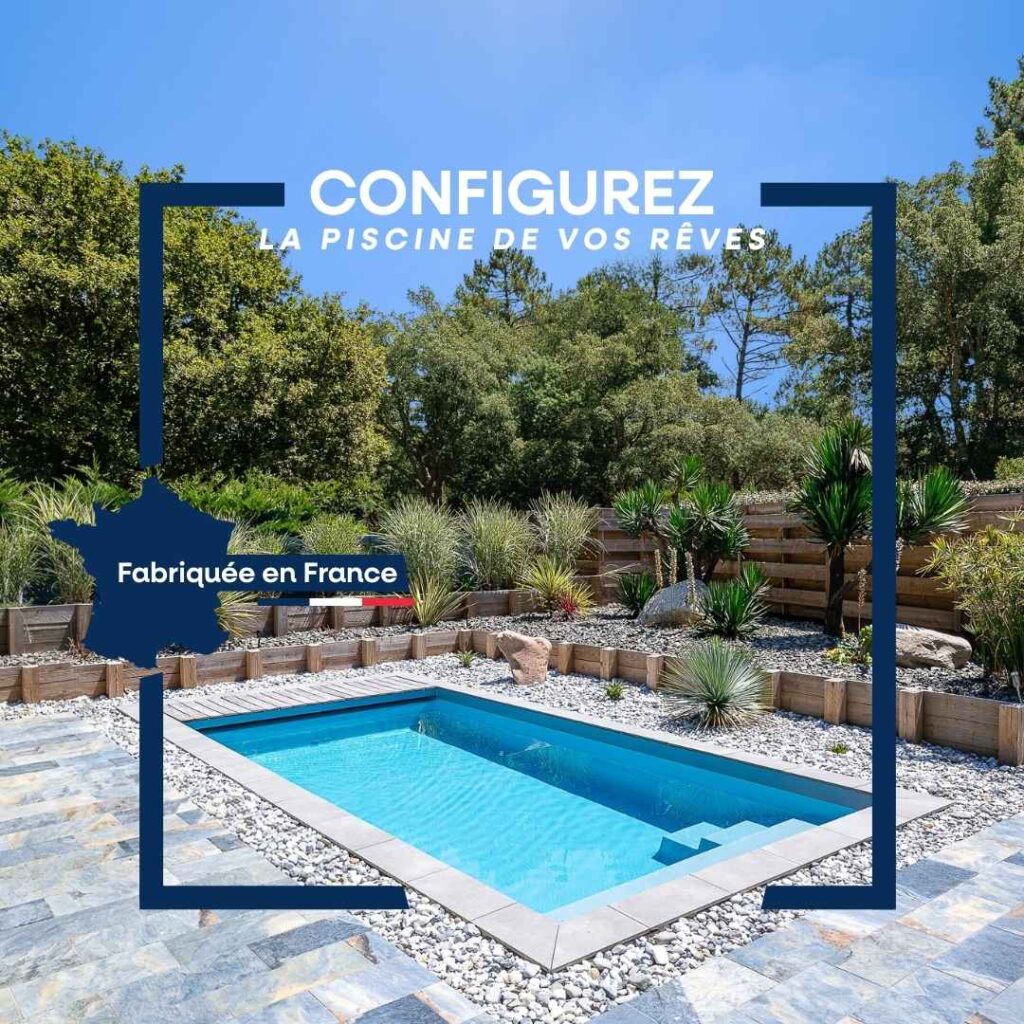
Our configurator allows you to view the 28 models and their colors before meeting a retailer.
(1) Subject to transport, specific access, and weather conditions
Share this article

You may be asking yourself these questions?
For a concrete pool, a liner is the cheapest solution to purchase (starting from approximately €10/m²) and it lasts 10 to 12 years. Paint, about €20/m² for supplies, needs to be redone about every 5 years. For a shell pool, comparing a price per m² does not make sense: the finish is included in the basin.
The easiest to clean are smooth coatings: gelcoat, liner, or reinforced membrane. Non-porous, gelcoat also limits the buildup of impurities and the need for treatment products. Tile requires monitoring the grout joints. Regardless of the coating, the waterline should be cleaned at least once a week.
The least slippery one is that which receives an anti-slip treatment: anti-slip liner or suitable tiling.
Yes for gelcoat and tiling, with a caveat for the liner: it does not handle water temperatures above approximately 28 °C well.
Discoloration, blisters, cracks, a wrinkled or peeling liner, or a drop in water level are signs of wear. Have them diagnosed by a professional before repairing.
There is no absolute best coating: it all depends on the structure. On a hull, it is the gelcoat, integrated into the basin. For a concrete pool, tiling is the most durable, about 50 years excluding joint repairs, while the liner remains the most economical to purchase.
A liner lasts on average 10 to 12 years. A reinforced membrane, thicker and strengthened with a mesh, lasts about 15 to 20 years.
No, that is not necessary: a hull is already watertight thanks to its gelcoat, which acts as its coating. For a hull, you choose a color at the time of order rather than a coating to be applied.
On the same topic
Your fiberglass pool project is waiting for you!
Configure your shell pool in just a few clicks or find your nearest Aboral distributor for personalized support from start to finish.