What kind of pool on non-buildable land?
Written by:
Modified on:
Reading time:
Article outline
- Can a swimming pool be installed on non-building land?
- Understanding your land's zoning: what the PLU says
- What swimming pool solutions are available for non-buildable land?
- Steps, authorizations, and risks to be aware of
- The translation "Assess the feasibility of your project with Aboral Piscines" accurately conveys the meaning and maintains the required verbatim element.
Contrary to what one might believe, non-building land does not systematically condemn your swimming pool project. This is a misconception that wrongly discourages many owners of individual houses.
In reality, the possibility of installing a swimming pool on non-buildable land depends on several specific criteria: the nature of the zoning, the presence of an existing dwelling, and the local urban planning regulations. Depending on the case, some solutions remain perfectly feasible, while others expose you to real legal and financial risks. The key is to know how to distinguish between the two before committing.
This article gives you concrete benchmarks and key steps to decide with confidence.
In summary:
- On non-buildable land, a concrete swimming pool requiring a permit is generally refused, but solutions remain possible depending on the zoning.
- The classification of the plot (natural, agricultural, floodable zone) and the presence of an existing dwelling are the determining criteria.
- A town planning certificate allows you to check for free what you are allowed to do before any commitment.
- An unauthorized installation exposes you to heavy fines and possible restoration: it is better to anticipate.
Can a swimming pool be installed on non-building land?
The answer is nuanced, as it all depends on your land's classification and local regulations.
Legally, a in-ground pool is considered a construction. However, on a non-buildable plot, the administration generally refuses permits related to new constructions.
This does not condemn all projects. A demountable above-ground swimming pool, an installation attached to an existing dwelling, or an arrangement provided for by the local regulations may sometimes still be possible.
The starting point is therefore to precisely identify why your land is not buildable, as each zoning obeys different rules. Before purchasing any equipment or signing any quote, checking the feasibility with your local council avoids unpleasant surprises.
Understanding your land's zoning: what the PLU says
The PLU (Local Urban Plan) divides each municipality into zones with distinct rules, and it is this classification that determines what you can install.
Natural, agricultural, or flood-prone area: what are the differences?
- In a natural area (N), construction is heavily restricted to protect landscapes, but a swimming pool can sometimes be tolerated as an extension of an existing dwelling.
- In an agricultural zone (A), constructions are in principle reserved for agricultural activity, and a leisure project is rarely accepted there, except by specific provision of the PLU.
- In a flood-prone area, subject to a Risk Prevention Plan, swimming pools are often regulated, or even prohibited, so as not to impede water flow.
These distinctions explain why two neighbors can receive opposite answers.
The role of the town planning certificate in dispelling doubt
Before you plan, a simple and free step changes everything: requesting a planning certificate from your town hall.
This official document indicates the rules applicable to your plot and specifies whether your project is feasible. It exists in two forms: an information certificate, which details urban planning provisions, and an operational certificate, which directly answers the feasibility of a specific operation.
Asking the latter by describing your pond project gives you a clear, written, and enforceable answer, rather than mere assumptions. It's a valuable reflex, as it prevents you from incurring costs on a project that would be refused anyway.
What swimming pool solutions are available for non-buildable land?
Several options are worth considering depending on your situation, with clear differences in comfort, durability, and authorizations.
The above-ground or inflatable pool: the most flexible solution
It is often the first option to consider on non-buildable land.
An above-ground pool, installed temporarily and without permanent anchoring, often escapes planning permission and certain taxes. It allows you to enjoy swimming without undertaking heavy work.
Its limitations remain real: less comfort, less integrated aesthetics in the garden, and generally seasonal use.
Good to know:
An above-ground pool is exempt from formalities only if it remains truly temporary. Left in place all year round, anchored to the ground or connected to fixed equipment, it can be reclassified as a permanent installation by the administration, and thus become subject to urban planning rules and taxation again.
The shell mini-pool: the aesthetic and durable solution
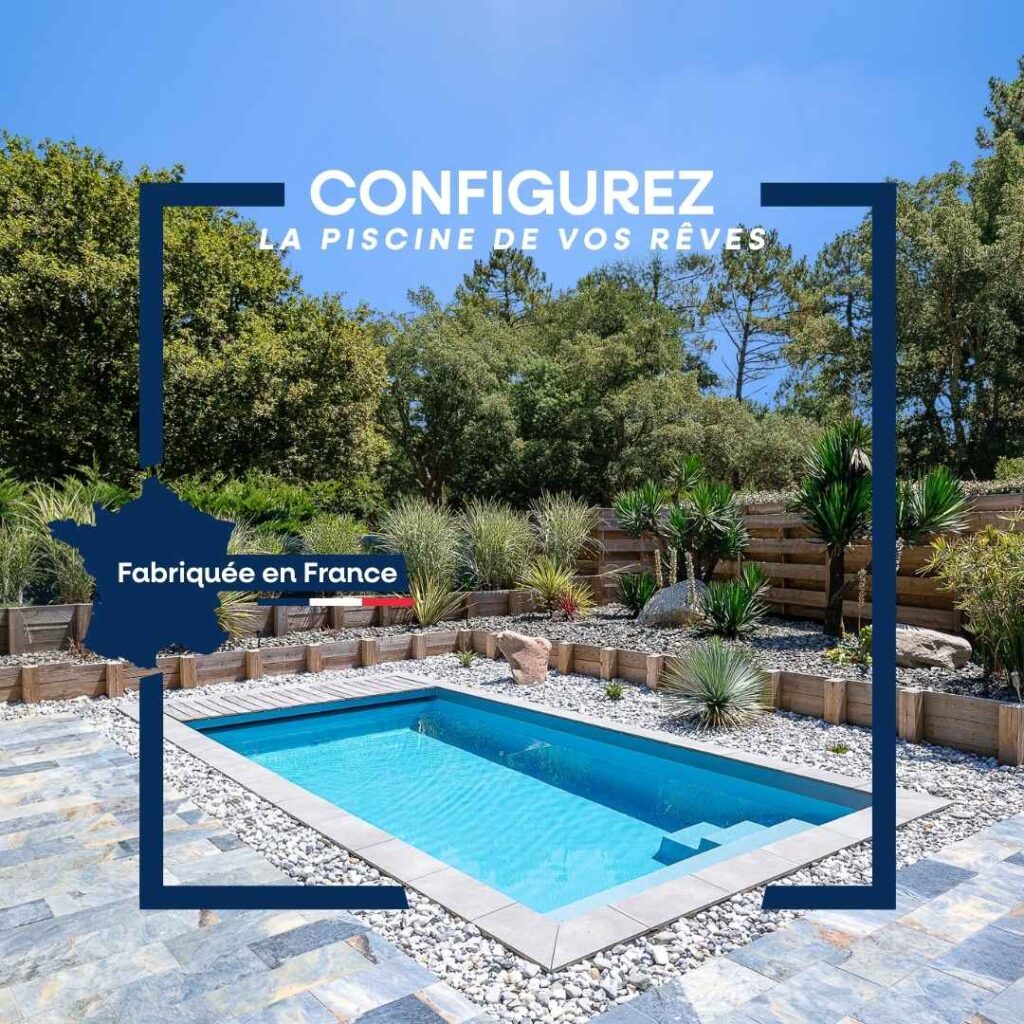
If a house is already legally built on your plot, the polyester shell mini-pool becomes a particularly interesting track.
Some PLU (Local Urban Plan) do indeed allow for limited developments around an existing dwelling, even in constrained zones, provided they remain proportionate. With a surface area often less than ten square meters, the mini shell pool fits into this logic: it frequently escapes formalities while offering real year-round comfort.
Depending on your situation, several options are available to you to successfully complete your swimming pool construction project:
- You can request a modification or revision of the PLUfrom the town hall, using a reasoned file showing that the swimming pool does not harm the environment or the development of the municipality.
- You can also prove that the pool constitutes an extension of your home, with plans and quotes to support it, or request an exemption by demonstrating that the project complies with the Urban Planning Code.
Steps, authorizations, and risks to be aware of
Before launching your project, it's best to know the necessary permits. The regulation of a swimming pool directly depends on the surface area of the pool: the larger it is, the more regulated the procedures are.
Prior declaration or building permit: when and for what?
As a general rule, a pool of less than 10 m² requires no formalities, a pool from 10 to 100 m² requires a prior declaration, and beyond 100 m² a building permit becomes necessary.
But on a non-build zone, these thresholds are not enough. Even a small swimming pool remains subject to zoning rules, which can simply prohibit it.
In other words, respecting the surface area never guarantees authorization. It is the combination of the nature of the basin and the classification of the plot that determines the final response from your town hall.
The risks of an unauthorized swimming pool
Installing a pool without authorization on non-buildable land is a risky gamble.
The administration has powerful tools, combining satellite imagery and artificial intelligence, to detect undeclared pools. In case of an offense, the penalties are real: a fine of up to €6,000 per square meter built, back taxes, and, in the most serious cases, an obligation to restore the site.
In addition, there is a loss in case of resale, as irregular work significantly complicates the transaction. Regularity therefore directly protects your investment.
The translation "Assess the feasibility of your project with Aboral Piscines" accurately conveys the meaning and maintains the required verbatim element.
Faced with non-buildability, support often makes the difference between an abandoned project and a secured project.
At Aboral Piscines, we help each owner analyze their situation upstream: reading the zoning, directing them to the right procedures, and site study adapted to the land's constraints. This transparent approach, built on over 30 years of experience, avoids false hopes and costly mistakes.
Building a swimming pool is above all a life project that deserves to be built on solid foundations.
On non-buildable land, the key is not to give up too quickly or force the issue, but to understand precisely what your zoning allows. Between a removable above-ground pool, landscaping around an existing dwelling, and integrated shell pools, options exist depending on your situation.
By checking the regulations, obtaining a planning certificate, and relying on expert support, you transform an apparent constraint into a controlled project. Want to get a clear picture of your project? The Aboral Piscines teams can study it with you, step by step.
Share this article

You may be asking yourself these questions?
This depends on the zoning and what already exists on the plot. An in-ground swimming pool requiring a permit is often refused, but a removable installation or one attached to an existing dwelling may sometimes still be possible, depending on your municipality's regulations.
Consult the Local Urban Plan at the town hall or request a certificate of urbanism. This free document specifies the classification of your plot, the applicable rules, and what you are actually allowed to build there, without taking any risks.
It is rarely accepted for recreational use, as constructions in agricultural zones are in principle reserved for agricultural activity. An exception is still possible if local regulations allow it and if the project accompanies an existing dwelling on the land.
In natural areas, construction is strictly limited to preserve landscapes. However, a swimming pool may be tolerated in certain cases, particularly as an extension of an existing dwelling, if the local urban plan (PLU) allows it. The answer always depends on the precise regulations of your municipality.
A pool of less than ten square meters or a truly removable and temporary above-ground pool often escapes the need for a permit. Be careful, however: on non-buildable land, these pools remain subject to zoning regulations, which may still prohibit them.
This is an official document issued free of charge by the town hall. It indicates the urban planning rules applicable to your plot and, in its operational version, specifies whether your swimming pool project is feasible. An essential step before incurring any study or material costs.
Sanctions are real: a fine of up to six thousand euros per square meter built, tax recovery, and, in the most serious cases, an obligation to restore or even demolish. An irregular structure also significantly complicates a resale.
On the same topic
Your fiberglass pool project is waiting for you!
Configure your shell pool in just a few clicks or find your nearest Aboral distributor for personalized support from start to finish.