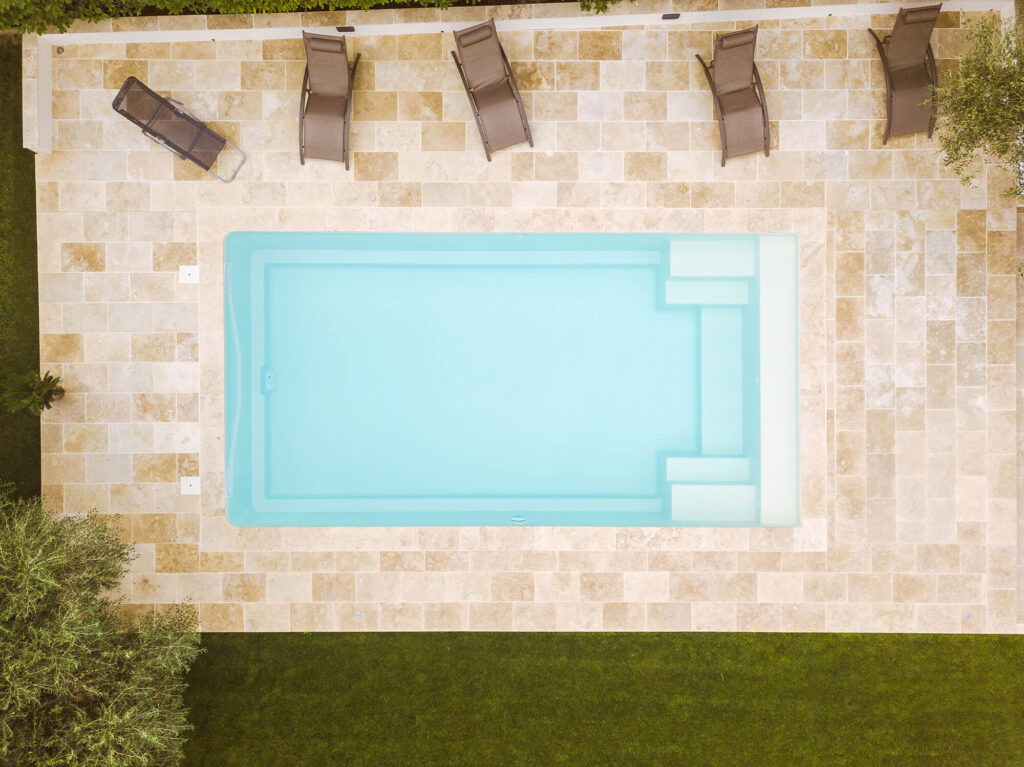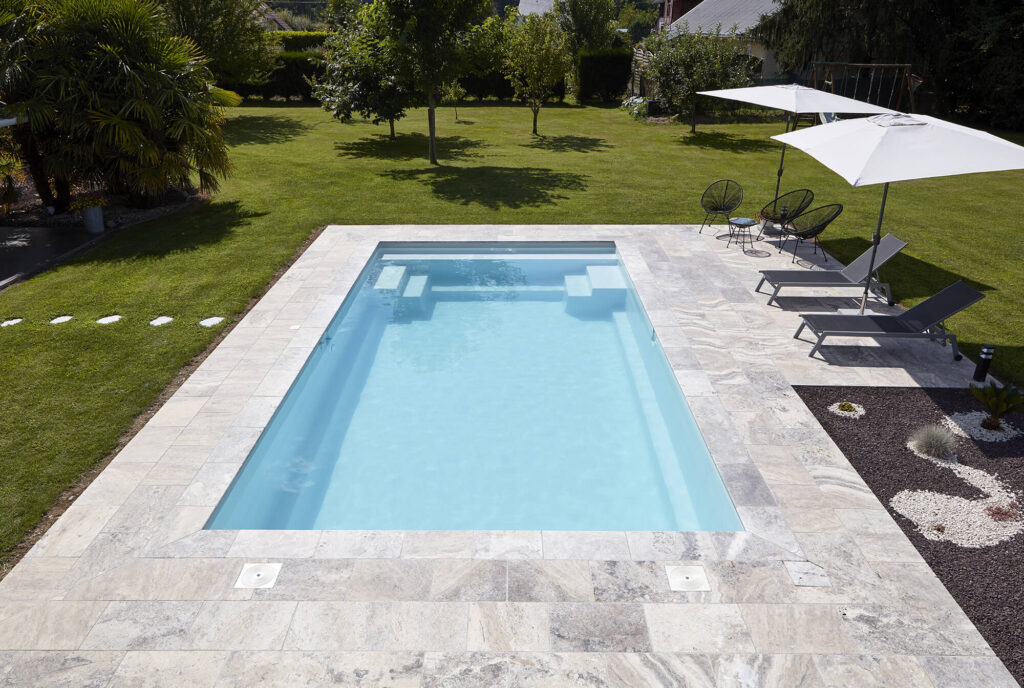
Building an 8x4 shell pool is the kind of project that truly changes your life: more time spent outdoors, increased garden value, and everyday comfort. But before diving in, many wonder: "What about taxes, what does that really mean?"
In reality, the taxation of your pool depends mainly on your municipality and the type of pool chosen (in-ground, semi in-ground, or above-ground pools). There are also local rules (sometimes exemptions) that allow you to keep control of your budget.
In this guide, you will discover what an 8x4 pool really costs in taxes, how these amounts are calculated, and above all, the points to know to anticipate and avoid unpleasant surprises.
Mandatory taxes for an 8×4 swimming pool
As soon as an 8x4 shell pool is installed, two taxes automatically come into play:
- Thedevelopment tax, linked to the works,
- and the property tax, linked to the value of the property.
They are what constitute the bulk of the taxation of an in-ground or semi-in-ground swimming pool.
Please note: Since 2023, the housing tax no longer applies to private swimming pools in primary residences. However, for secondary residences, the presence of a swimming pool may still be taken into account.
Development tax: a one-time cost upon installation
A fixed, national calculation basis
The development tax is the most significant tax when installing your swimming pool. It is a one-time levy, calculated on the basis of a national flat rate that is updated annually.
For 2026, this flat-rate value amounts to 251 euros per square meter of taxable area.
A 8x4 swimming pool has a floor area of 32 m², which gives a calculation base of 8,384 euros.
A variable portion depending on your municipality
In addition to this base amount, there are the rates voted by your municipality and your department:
- Themunicipal rate can range from 0% to 5%,
- Thedepartmental rate ranges from 0% to 2.5%.
The actual range you will pay is therefore between €80 and €650 depending on your geographical location:
- A municipality that applies low rates (1% municipal rate and 0.5% departmental rate) will charge you approximately €83.
- A municipality with the maximum rates (5% + 2.5%) will charge a development tax of €628 for exactly the same swimming pool.
Property tax: the permanent annual increase
Installing a swimming pool improves the comfort, use, and appeal of your home… and this is reflected in your property tax. Specifically, adding a pool increases the cadastral rental value of your home, which serves as the basis for calculating the tax.
The calculation of property tax takes place in three steps:
1. Determination of the new cadastral rental value
It depends in particular on:
- of thebasin's surface,
- the characteristics of your property,
- and the scale applied by the administration.
2. Application of a 50% reduction
Once the rental value has been revised, the administration automatically applies a flat-rate deduction of 50%.
3. Application of the local tax rate
The result obtained is then multiplied by the rate voted by your municipality, which varies greatly from one territory to another.
This is the rate that explains the differences: a 8x4 swimming pool can lead to an increase of about €120/year in a low-taxed rural municipality, compared to €400/year in a large, highly taxed city.
Summary table of taxes on an 8×4 swimming pool
To better visualize the tax impact of an 8x4 swimming pool, here are three representative scenarios: a low-tax municipality, an average municipality, and a municipality with among the highest rates.
This allows you to quickly understand how taxes evolve over time based on your location.
| Scenario | Development tax (year 1) | Property tax (per year) | Total cost for year 1 | Cumulative cost over 5 years | Cumulative cost over 10 years |
| Low taxation | ~ 83,8 € | ~ 120 € | ~ 203,8 € | ~ 683,8 € | ~ 1 283,9 € |
| Average taxation | ~ 342,7 € | ~ 240 € | ~ 582,7 € | ~ 1 542,7 € | ~ 2 742,7 € |
| High taxation | ~ 628,8 € | ~ 400 € | ~ 1 028,8 € | ~ 2 628,8 € | ~ 4 628,8 € |
These estimates show how muchlocal taxation can vary the total cost.
This is why it is essential to check the rates applied in your municipality before finalizing your project: a simple change of territory can have a significant impact on your overall budget.
Tax on the construction of an 8×4 swimming pool: calculation, examples, and payment terms
Precisely understanding how your development tax is calculated allows you not only to anticipate the exact amount but also to detect any errors in your tax notice.
Full formula for the development tax
The development tax is calculated using the following formula:
Development tax = surface area x flat rate € x rate (municipality + county)
Let's break down each element:
- The taxable surface corresponds to the ground surface area of your pool, measured from inner edge to inner edge. Caution: if you install a covered terrace or a pool enclosure, these elements may also be taxable and will be added to the calculation.
- The national flat rate, updated annually by decree. For 2026, it stands at €251 per square meter for swimming pools.
- Themunicipal rate is voted on by the municipal council and can range from 0% to 5%.
- The departmental rate is decided by the departmental council and ranges between 0% and 2.5%.
You can do a simulation of your development tax amount on the official government website.
2 examples of applications of the development tax
To illustrate these calculations in concrete terms, let's take two examples representative of real situations in different French municipalities.
Example 1: Installation in Bordeaux (Gironde, New Aquitaine)
Mr. Dupont is having a 8x4 shell pool installed on his Bordeaux property. The applicable rates in 2025 are:
- Bordeaux municipal tax rate: 5%
- Gironde department rate: 2.5%
Here is the detailed calculation:
- Taxable area: 32 m²
- Calculation basis: 32 × 251 = €8,032
- Multiplier coefficient: 0.05 + 0.025 = 0.075
- Total development tax: 8,032 x 0.075 = €602.4
Mr. Dupont will receive his tax notice for approximately €602.4 about 12 to 18 months after filing his certificate of completion of works.
Example 2: Installation in a rural community (Dordogne, New Aquitaine)
Mr. and Mrs. Lefèvre are installing their 8×4 swimming pool in a small rural town in the Dordogne region, which has an attractive tax policy. The 2025 rates are:
- Municipal rate: 0% (total exemption)
- Departmental rate for Dordogne: 1%
Detailed calculation:
- Taxable area: 32 m²
- Calculation basis: 32 × 251 = €8,032
- Multiplier coefficient: 0 + 0.01 = 0.01
- Total development tax: 8,032 × 0.01 = €80.32
This is the most favorable situation: the couple saves more than €500 compared to Bordeaux, simply because there is no municipal tax and the departmental tax rate is low.
When and how is it claimed?
The declaration of the development tax is made directly in your "Real estate" space on impots.gouv.fr. You must send it within 90 days of the completion of the works, an imperative deadline to avoid penalties and loss of exemptions.
Once this declaration is registered, the administration will send you your payment notice from 90 days after completion, after verifying your file.
Payment then depends on the amount owed:
- Less than €1,500: payment in one installment,
- Over €1,500: payment automatically split into two installments, six months apart.
The deadlines indicated on the notice must be respected: the first payment must be made within 15 days, otherwise penalties of 10% and late payment interest will apply.
Property tax on an 8×4 swimming pool: calculation, examples, and payment methods
Unlike the development tax, the property tax is levied each year as soon as your swimming pool is installed.
This tax is linked to the cadastral rental value (CRV), meaning the theoretical value your property would represent if it were rented out. An in-ground swimming pool is considered a permanent built element, thus automatically increasing this CRV.
Full property tax formula
The property tax is calculated from 50% of the cadastral rental value of your property. Adding a swimming pool can increase this value, but it is not the only element taken into account. Several criteria come into play.
The gross area of the property
The gross area corresponds to the total area of the property, without any deductions. It includes, in particular:
- walls and partitions,
- the stairs,
- door and window frames,
- as well as the land, regardless of the existing construction.
This surface allows the administration to assess the overall size and potential of the property.
The pool and its features
This is where the pool comes into play.
Thegross surface area of the pool, itstype (in-ground, semi-in-ground, or permanently installed above-ground pool), its dimensions, and sometimes its depth are included in the cadastral value and contribute to its increase.
The reference price per square meter and local rates
Each municipality sets a reference price per square meter, which is regularly reevaluated.
In addition to this:
- themunicipal rate, voted by the municipal council,
- and sometimes an inter-municipal tax, intended to finance shared facilities and services (transport, land use planning, etc.).
These rates explain the significant differences in property tax between municipalities.
Example of how the housing tax is applied
Please note: This calculation is an educational estimate. In reality, the administration applies additional weighting coefficients (seniority, usage, equipment, etc.), which explains the possible differences between properties.
Let's take a concrete example, deliberately simplified to better understand the mechanism.
Mrs. Martin owns a 90 m² house in Nantes, equipped with a 30 m² swimming pool. The reference rates used are as follows:
- Housing: €12/m²
- Swimming pool: €5/m²
Step 1: Calculating the gross cadastral value
- House: 90 × 12 = $1,080/month
- Swimming pool: 30 × 5 = $150/month
- Total: €1,230/month, or €14,760/year
Step 2: Application of the 50% reduction
- 14 760 € × 50 % = 7 380 €
Step 3: Application of the municipal rate
- Municipal tax rate in Nantes: 46.34%
- €7,380 × 46.34% = ≈ €3,419/year
In this example, the annual property tax with a swimming pool reaches approximately €3,419.
Temporary two-year exemption: are you affected?
Good news: in some municipalities, installing a swimming pool may entitle you to a temporary property tax exemption for two years. This measure applies to new constructions, including in-ground and semi-inground pools, but it is not automatic.
Two conditions must be met:
- Your municipality must have voted for this exemption by deliberation,
- The pool must be declared to the tax authorities within 90 days of completion of the work. In the event of late declaration, the exemption is permanently lost.
To find out if you are eligible, you can consult your local council's deliberations, contact the property tax department, or check the local taxation section on your municipality's website.
Aboral Piscines: comprehensive support that goes far beyond installation
Recognized expertise in support services
Choosing Aboral Piscines for your project is not just opting for a quality technical installation: it is also benefiting from complete and personalized support from the very first steps.
This includes project study, advice tailored to your needs, and assistance with preparing the application file for the town hall (building permit, prior declaration of works, etc.), which is often unknown to individuals.
Feedback from our customers
For over 30 years, Aboral has been designing, manufacturing, and installing polyester shell pools with recognized expertise, as confirmed by customer feedback.
⭐⭐⭐⭐⭐ Charles – 5/5
« Communication was excellent right from the start. The project planning went smoothly and the turnaround time was very short. They installed an in-ground pool for us. The staff were perfect. I highly recommend this company. »
⭐⭐⭐⭐ Vincent – 4/5
« Very good contact. Clear explanation from the technician following the installation of the equipment. »
⭐⭐⭐⭐ Julien – 4.5/5
« The service was provided exactly as I wanted, on time, neatly, and I am happy with the end result. »
Thanks to this expertise, Aboral supports you in all sensitive areas: local urban planning, preliminary declarations, taxation, tax deadlines, etc. These are all issues that can quickly become complex without support.
It is this combination of technical expertise, personalized advice, and administrative support that makes Aboral Piscines a safe choice for a project managed from start to finish.
Launch your pool project with complete peace of mind with Aboral Piscines: technical expertise, transparency, and comprehensive support to transform your garden into a true living space.
FAQ – Taxes and taxation for an 8×4 fibreglass pool
1. Is an 8×4 swimming pool taxable?
An 8×4 shell swimming pool, when in-ground or semi-in-ground, is considered a permanent structure. It is therefore subject to development tax (once only) and property tax (annually).
2. How much is the property tax for an 8×4 swimming pool?
For an 8×4 shell pool, the increase in property tax averages between €120 and €400 per year, depending on the rate applied by your municipality.
3. How much is the development tax for an 8×4 swimming pool?
For a 32 m² swimming pool, the development tax generally varies between €80 and €650, depending on the rates voted by your municipality and department. It is calculated on the basis of a national flat rate that is updated each year.
4. What is the fine for an undeclared swimming pool?
An undeclared swimming pool can result in a fine of up to €150 per square meter of undeclared surface area.
5. What is the surface area of a swimming pool that is not subject to tax?
According to the General Tax Code, mini-pools smaller than 10 m² are not taxable, as are above-ground or removable pools, provided that they do not require any earthworks and can be moved without demolition.