Installing a swimming pool at home is a dream that many families aspire to: enjoying the summer, adding value to their home, sharing fun times together... But very quickly, one question arises: "Will I have to pay more taxes if I install a swimming pool?"
The answer is not always obvious, astaxationdepends on several criteria: thesize of the pool, its type (in-ground, semi-in-ground, above-ground pool), whether it is permanent or removable, and sometimes even the area where your land is located.
In this article,Aboral Piscineswe provide a comprehensive overview to help you see clearly before finalizing your project.
Understanding swimming pool taxation
Before even talking aboutdimensions, it is important to understand why some pools lead to taxation and others do not. A pool is not just a place to swim: for the administration, it is aconstructionthat can modify the value of your home.
What is a taxable swimming pool?
A swimming pool is considered taxable when it isfixed to the groundand cannot be moved without requiring major work. This is the case forin-ground pools,semi-in-ground poolsor shells placed on a slab.
These amounts are then added to therental value of the propertyfor tax purposes, which is the estimated value that the tax authorities use to calculate certain local taxes.
Result: theproperty taxon your house is increasing.
Which taxes are affected?
There are three main taxes associated with owning a swimming pool:
- Property tax: this is calculated each year based on the cadastral value. A swimming pool, even a medium-sized one, can add several hundred euros to the bill.
- The development tax: it is a one-time tax, paid the year after the work is completed. Its amount depends on the surface area of the pool and a scale set by the State and the municipality.
- The residence tax : it no longer exists for primary residences, but remains applicable for certain secondary residences. If you own a holiday home with a swimming pool, it may therefore be taken into account.
To remember: the swimming pool is above all acomfort element, and as such, it is included in the calculation of local taxes as soon as it is considered a durable construction.
What is the maximum size of a swimming pool that is not subject to tax?
This is the question everyone is asking:"What area must I respect for my pool not to be taxed?" The answer is clear:a pool with a surface area less than or equal to 10 m²is exempt from taxes.
The threshold explained simply
Below 10 m², your pool is considered too small to affect the cadastral value. In this case, it is exempt fromproperty taxanddevelopment tax.
It is this threshold that makes the difference between a tax-neutral project and a project that results in additional taxes.
What does that mean in practical terms?
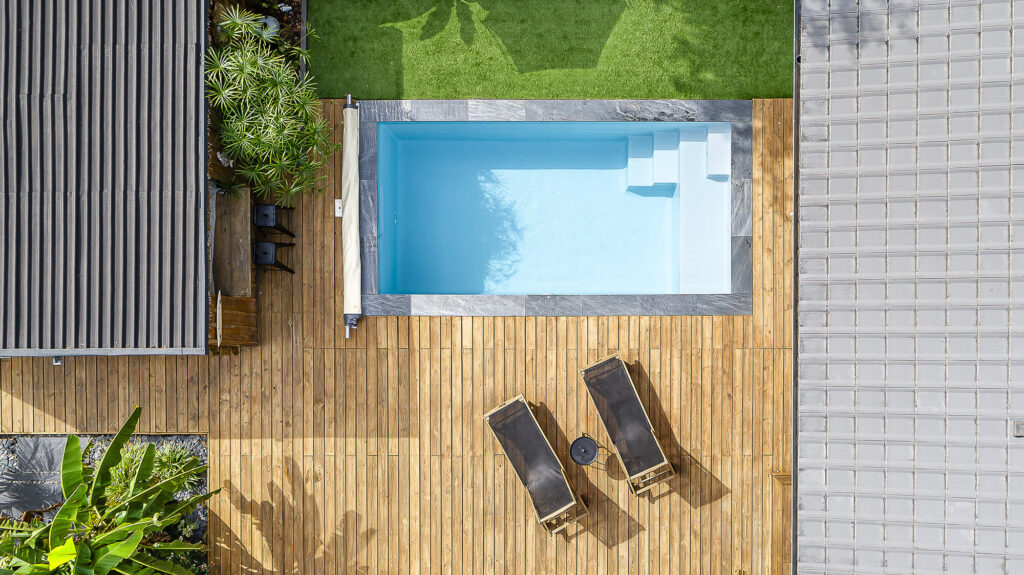
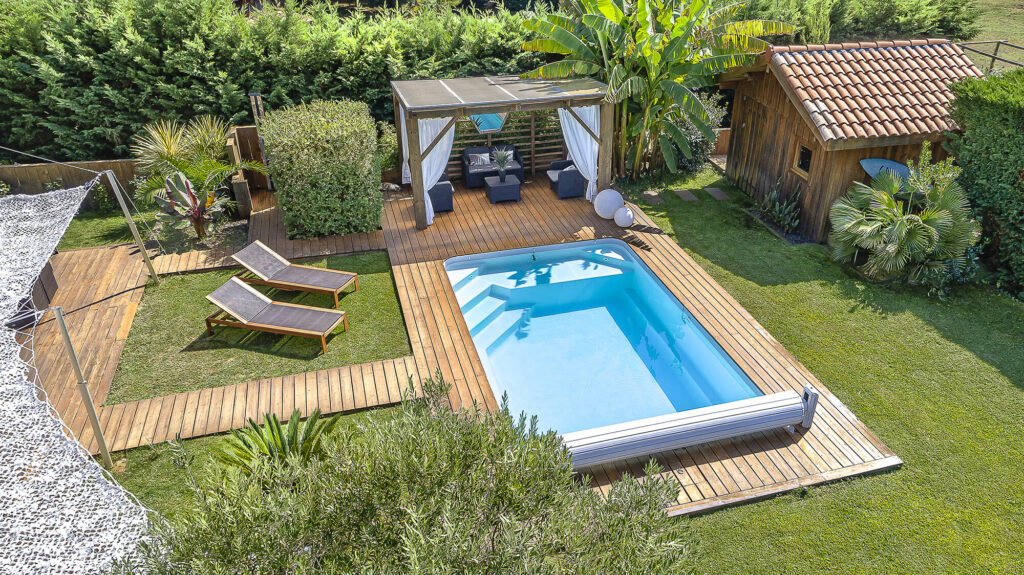
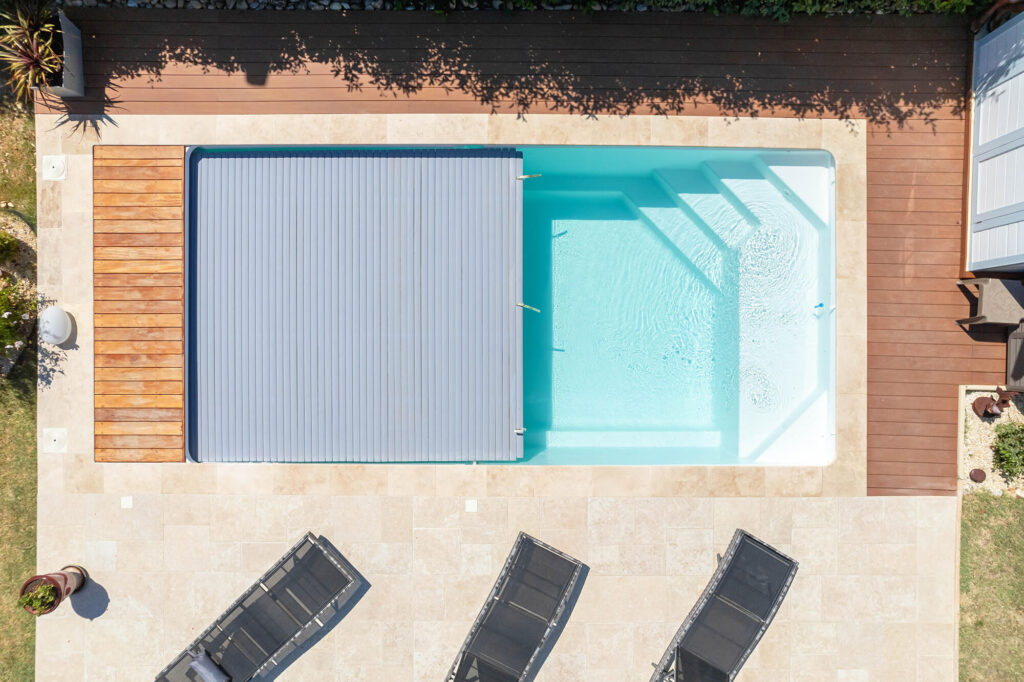
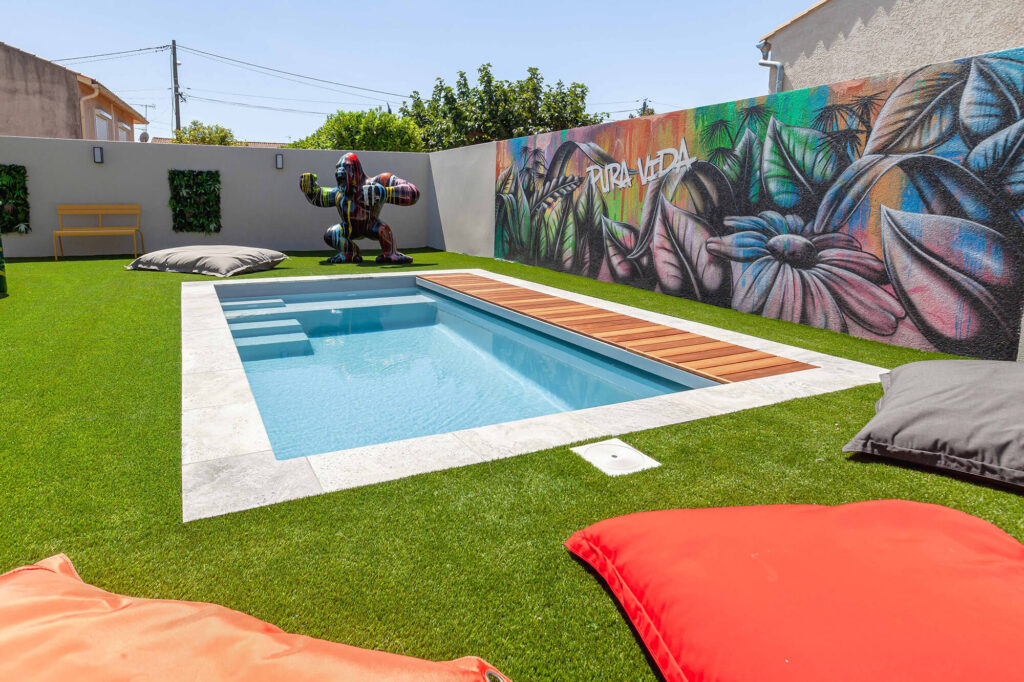
Some typical dimensions for visualization:
- 3 × 3.33 m, a cozy little square,
- 4 × 2.5 m, a rectangular shape ideal for small gardens,
- 5 × 2 m, an elongated format that already allows you to enjoy a real swimming area.
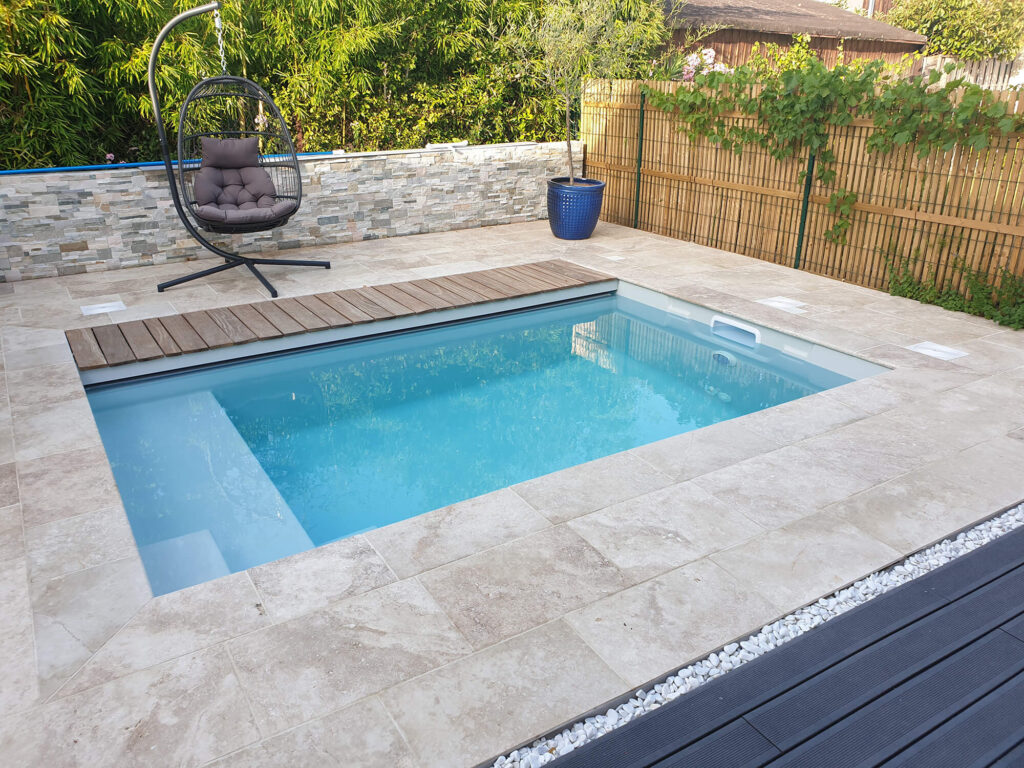
Thesemini-poolsremain true relaxation spaces, often equipped with modern systems (counter-current swimming, heating, lighting), while escaping taxation.
Exceptions to remember
Please note, however, that even pools smaller than 10 m² may be subject to tax. This is the case if they are installed in a listed site or a protected area, where the PLU (Local Urban Planning Plan) imposes stricter rules.
Another special case: pool enclosures. Even if your pool remains below the 10 m² threshold, installing an enclosure over 1.80 m high requiresa building permit. In some cases, this construction may have a tax impact, as it is considered an extension of the dwelling.
What administrative procedures should be planned for?
Installing a swimming pool is not just a matter of taxes. You must also comply with certain urban planning regulations.
At city hall: declaration or permit?
- For a pool ≤ 10 m²: no formalities, unless your land is located in aclassified siteor subject to strict local urban planning (PLU).
- For a swimming pool of 10 to 100 m²: aprior declarationof works is mandatory.
- For a pool > 100 m² or with a cover over 1.80 m: you must submit abuilding permit application.
These steps enable the city hall to verify that your project complies with the local urban planning regulations.
Taxes: the 90-day rule
If your swimming pool is taxable, you mustdeclare it to the tax authorities within 90 daysof the completion of the work.
This is an essential step, as it allows you tobenefit from a temporary property tax exemption for two years.
What if you don't report it?
The administration can recalculate thecadastral value of your home, apply an adjustment, and add penalties. In other words, it is better to declare on time to avoid unpleasant surprises.
What is the real impact on your taxes... and on the value of your home?
The effect on property tax
A 20 m² swimming pool can add several hundred euros per year to your property tax. The exact amount depends on several criteria: thesurface area of the pool, thetype of pool(in-ground, semi-in-ground, permanent above-ground) and especially themunicipalitywhere your home is located, as each local authority applies its own rates.
The larger and more permanent the swimming pool, the greater its impact on thecadastral rental valueis.
The impact on property value
On the positive side, we must not forget the effect onreal estate value. The presence of a swimming pool can increase the value of your home by 5 to 20% depending on the region and market conditions. It is therefore a real asset when reselling, which often compensates for the additional tax cost.
In other words, even if you pay more local taxes, your property increases in value and becomes more attractive to future buyers.
Without forgetting that bydeclaring your pool to the tax authoritieswithin 90 days of the completion of the work, you can benefit from aproperty tax exemptionfor two years. This little boost helps to lighten the tax burden at the start and amortize part of the initial expense.
AtAboral Piscines, we assist our clients in choosing theirshell pool, taking into account not only their desires but also the fiscal impacts. Because a pool is not just about pleasure… it's also a project that requires intelligent preparation.
FAQ - What you need to know
→ Is a 9.5 m² swimming pool really tax-exempt?
Yes, a 9.5 m² swimming pool is tax-exempt, as it remains below the legal threshold of 10 m². However, please note that if it is built on land located in a classified site or protected area, it may require planning permission.
→ What happens if I slightly exceed 10 m²?
The rule is strict: above 10 m², the pool is considered taxable and must be declared.
→ Are semi-inground pools affected?
Yes, semi-inground pools are taxable once they exceed 10 m². Even if they are not completely inground, they are considered fixed and permanent, and are therefore included in the calculation of the cadastral value of your home.
→ Can the development tax be avoided?
Yes, the development tax can only be avoided if the pool is less than 10 m² or if it is above ground and removable. In all other cases, the development tax is automatically payable.
→ How can you take advantage of the exemption?
To benefit from a two-year property tax exemption, simply declare your swimming pool to the tax authorities within 90 days of the end of the work. This deadline is mandatory: after this period, you will lose your right to this reduction.
Configure your pool online Back to all news