Polyester or vinylester shell pool: how to make the right choice?
Written by:
Modified on:
Reading time:
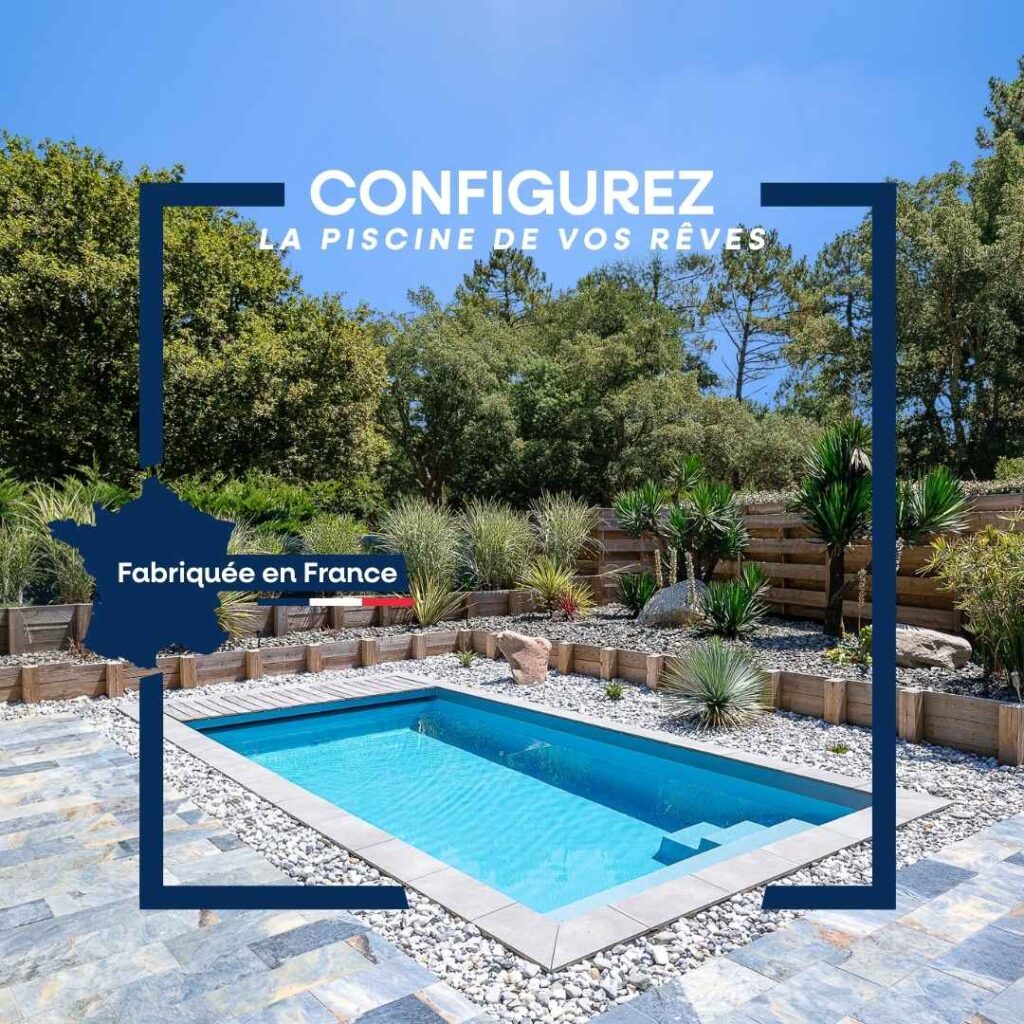
The polyester shell is today the type of in-ground pool the most widespread among individuals in France, ahead of sprayed concrete. The vinylester, he represents a recognized high-end alternative, favored in certain specific contexts.
An isophthalic polyester of quality offers durability perfectly suited for family use over decades. In more demanding terrain configurations, vinylester pools provide a superior level of protection that can make all the difference.
This article gives you the keys to choose between a fiberglass shell pool or a vinyl ester pool, depending on your land, your constraints, and your budget.
In summary:
- The polyester shell is the benchmark solution for the vast majority of in-ground swimming pools in single-family homes: good value for money, durable, economical to maintain.
- Vinyl ester is a high-end solution with superior performance, particularly suited for contexts with unstable soils or wet areas.
- Manufacturer warranties on gel coat and structure are the best indicator of a hull's true quality, regardless of material.
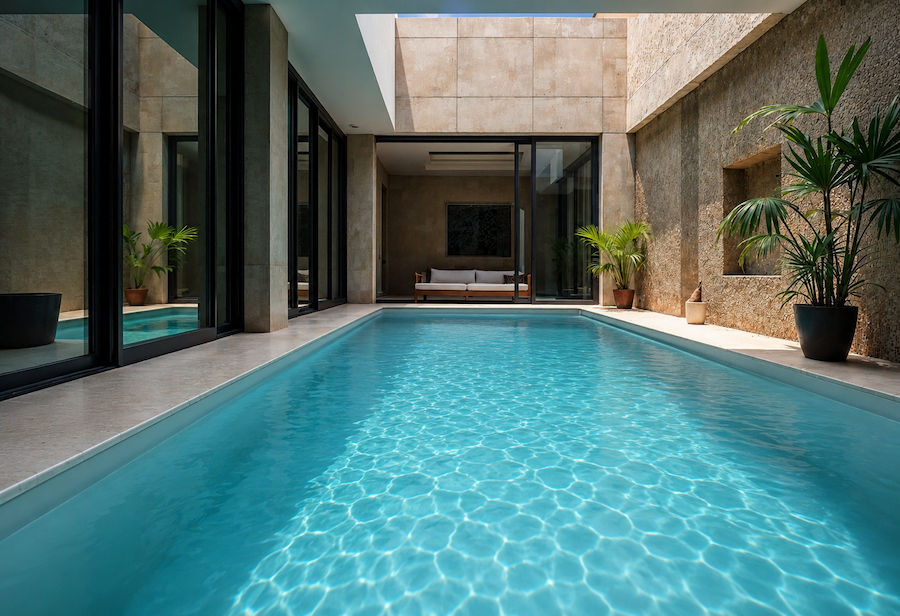
The polyester shell pool: the benchmark solution for individuals
Two polyesters, two performance levels
When talking about shell pools, we are primarily talking about polyester. It is the material that has become established for over 40 years in the manufacture of residential pools in France, for several reasons: lightness, speed of installation, watertightness, non-porous surface, and reduced maintenance.
However, not all polyester resins are equal, and that is precisely where the quality of a hull is determined:
- The orthophthalic polyester resin is the most basic version: economical to produce, but more porous and more sensitive to long-term water absorption.
- The isophthalic polyester resin, on the other hand, has a denser molecular structure, better chemical resistance, and significantly superior impermeability.
This is the version that equips the Aboral shell pools. When a swimming pool manufacturer talk about "polyester" without specifying the nature of the resin, that's the first question to ask.
The concrete advantages of a polyester shell for an owner
In practical terms, the polyester shell offers several advantages that owners appreciate on a daily basis:
- Its smooth, non-porous surface limits the adhesion of algae and bacteria, which reduces the frequency of treatments and the consumption of chemicals (an estimated saving of 30 to 50% compared to a shotcrete pool).
- Its installation is quick: a inground pool made of polyester shell can be installed in 4 days, compared to several weeks for a masonry pool.
- Finally, its intrinsic watertightness avoids the risks of leakage associated with degrading coatings, as is the case with aging liners.
The quality of a polyester hull: gel coat and resin layers
Two polyester shells can have the same dimensions, an identical visual appearance, and yet have radically different lifespans. The difference is not visible upon delivery: it may appear several years later, in the form of surface blisters, weakened waterproofing, or the risk of leaks at the bottom drain.
This phenomenon has a name: osmosis. And it is not an unavoidable consequence of polyester, it is the result of insufficient manufacturing.
What is osmosis?
Osmosis is the progressive penetration of water molecules through the resin layers of a hull, attracted by soluble substances present in the wall.
In the long term, this phenomenon:
- generates surface blisters,
- alters the smooth surface of the basin,
- weakens the seal at the bottom drain
- and can create costly leak risks to repair.
Its main cause? A low-density gel coat or the absence of a waterproof barrier layer in the laminate. In other words, osmosis is not a material problem, it's a manufacturing problem.
Gel coat and layer stacking: the two levers that make the difference
The gel coat is the first line of defense. The first layer applied in the mold, it determines the hull color, its resistance to UV and chemicals, and above all its surface impermeability.
A quality gel coat, like the Gelcoat Iso NPG Aquashine® used by Aboral Piscines, is on average twice as durable as a liner. A low-end gel coat, on the other hand, will gradually micro-crack and become the first point of entry for moisture. It is for this reason that the gel coat warranty period is one of the most reliable indicators for assessing a manufacturer's real confidence in its products.
But the gel coat alone is not enough. Behind it, it is the stacking of the internal layers that determines the structural longevity of the hull. For reference, here is the stacking used in hulls Aboral Piscines:
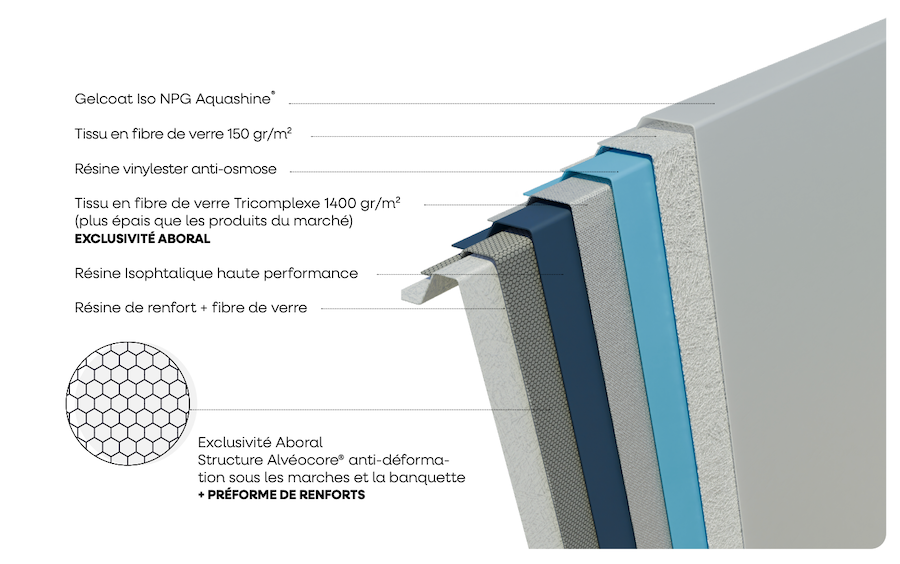
The diagram illustrates a key point: a quality polyester hull already incorporates a vinyl ester resin layer as an anti-osmosis barrier.
It is this hybrid approach, combining the advantages of both materials in a controlled stack, that explains why a good isophthalic polyester is no match for a 100% vinylester shell in the vast majority of residential contexts.
Polyester shell pool: in which specific cases is it worth the extra cost?
A polyester shell with an integrated vinyl ester barrier meets the needs of the vast majority of residential projects in France. But there are contexts where a fully vinyl ester structure represents the most suitable and durable solution:
- a very clayey soil subjected to strong landslides,
- a high water table generating permanent hydrostatic pressure,
- or a geographical area particularly exposed to infiltration.
In these cases, the higher molecular density of pure vinylester provides an additional level of protection that can make a difference over 20 or 30 years.
| Situation | Best choice | Explanations |
| Stable soil, well-drained | Polyester | Adapted performances, optimal value for money |
| Moderate clay soil | Polyester | The vinyl ester layer integrated into Aboral hulls offers sufficient protection |
| High water table | Vinylester | Superior waterproofing recommended |
| Very wet or floodable area | Vinylester | Maximum long-term protection |
| Standard residential use | Polyester | Material tested over 30 to 40 years |
The price difference between a polyester shell and a vinylester shell varies significantly depending on the manufacturers and the dimensions of the pool, with vinylester generally representing a higher investment, justified by its increased resistance to osmosis.
Guarantees and quality assurance: what you should demand, regardless of the material
Faced with two similar quotes, how to choose between two pool manufacturers The answer often comes down to a single criterion: the duration and scope of the guarantees offered.
Specifically, here are the guarantees that Aboral Piscines: commits to respecting for each pool delivered:
| Type of guarantee | Duration at Aboral | What it covers |
| Anti-osmosis gelcoat warranty | 10 years | The internal coating's resistance to osmosis |
| Waterproofing & structural warranty | 20 years | Wall, structural integrity |
| Ten-year warranty (installer) | 10 years | Structural integrity, waterproofing (legal obligation) |
The ten-year warranty is a legal obligation for the installer: it covers for 10 years any defects compromising the structural integrity of the work or making it unfit for its intended purpose. Manufacturer warranties, on the other hand, cover the material itself.
These two levels of protection are complementary and together constitute a true guarantee of quality for assessing the robustness of an offering.
You now have the keys to compare offers with clarity and ask the right questions to your future manufacturer. If you would like tailor-made support for your project, Aboral Piscines is available for an initial discussion.
Share this article

You may be asking yourself these questions?
Vinylester resin is denser and more waterproof than polyester resin. It offers better resistance to osmosis and chemicals. Isophthalic polyester resin is a good quality/price compromise on a stable surface.
Osmosis is the penetration of water into the resin layers, causing blisters and weakening the hull. It is avoided by an anti-osmosis vinylester resin layer applied just after the gel coat during manufacturing.
It is not systematically mandatory, but strongly recommended on wet, clayey soils or those close to a water table. It prevents hydraulic uplift which can deform or lift the hull.
Yes. The installer's ten-year warranty covers structural defects (cracks, waterproofing failures compromising solidity) for 10 years. It is separate from manufacturer warranties on the material.
Aboral pools integrate both: the main structure is made of high-performance isophthalic polyester, and a layer of anti-osmosis vinyl ester resin is applied as standard in all shells in the range.
On the same topic
Your fiberglass pool project is waiting for you!
Configure your shell pool in just a few clicks or find your nearest Aboral distributor for personalized support from start to finish.