Standard dimensions of a shell pool: what size to choose?
Written by:
Modified on:
Reading time:
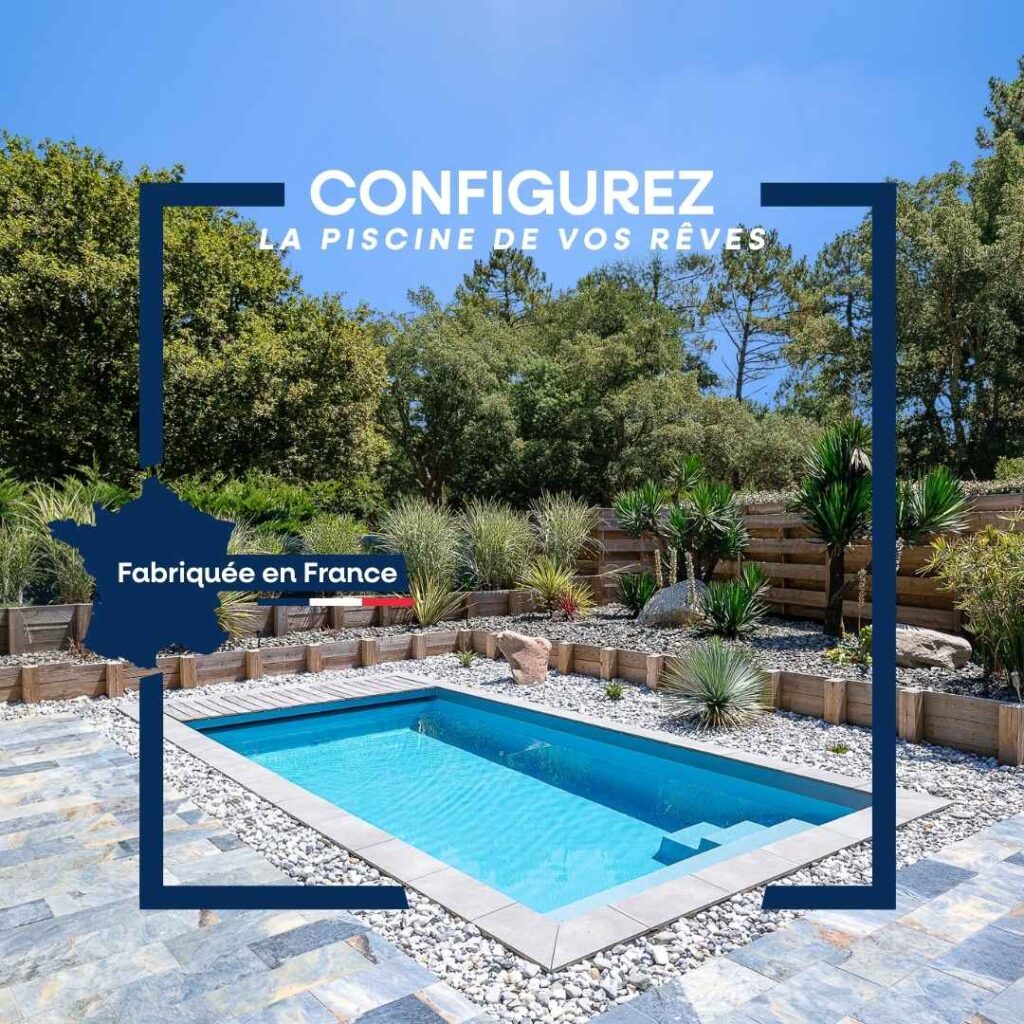
A swimming pool project often starts the same way: a family conversation, a too-hot summer, or simply the desire to enjoy your garden in a different way. Then comes the time to get serious and the first real decision to make is the size.
What standard pool size suits my land? My needs? My budget? These are seemingly simple questions, but they hide concrete issues: footprint, declaration obligations, impact on property tax, annual maintenance costs… This article untangles it all, point by point.
In summary:
- The standard dimension of a polyester shell pool ranges from 3.15 m to 10.80 m in length.
- The ideal size depends on three key criteria: the desired use (swimming, sport swimming, relaxation), the available space in the garden, and the investment budget.
- Beyond comfort, the size of your pool has a direct impact on administrative procedures (prior declaration or building permit) and on annual taxation (property tax).
- Personalized support helps avoid sizing errors and secures the project from the outset.
What pool size to choose according to your use?
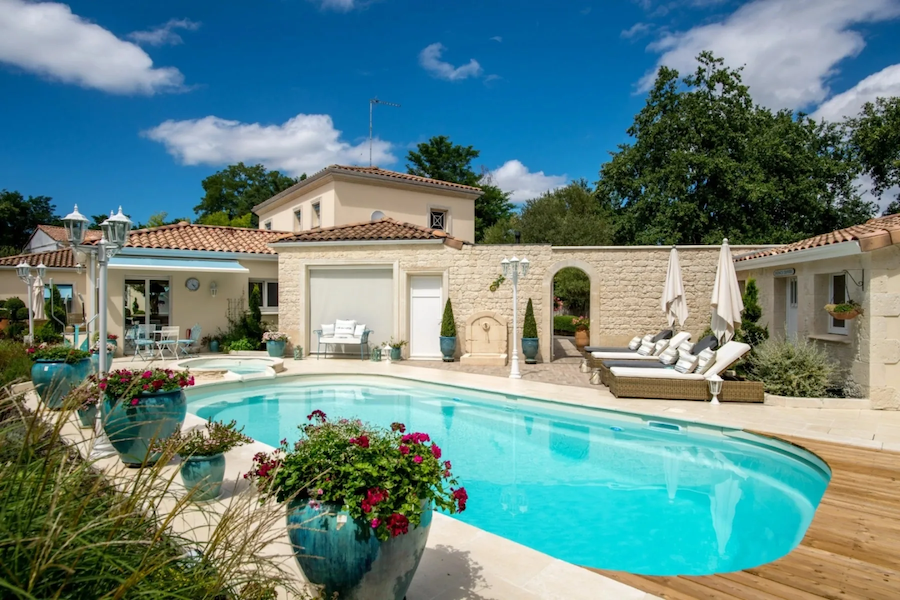
The size of a swimming poolis not chosen on a whim: it is chosen based on what you really expect from the pool on a daily basis. Water games with young children, morning laps, family relaxation on the weekend, or all three at once… Each use corresponds to a different range of dimensions.
Small garden or relaxation use: mini-pools under 10 m²
Not all gardens can accommodate a 7-meter rectangular swimming pool. Some owners have limited space, a particular configuration, or simply prefer to restrict the pool's location to keep a functional garden around it.
For these situations, mini-pools are often the most suitable answer. A 3.15 m x 3.15 m or 4 m x 4 m shell pool can be installed in a reasonably sized space, even on a 200 to 300 m² plot. This type of format is well-suited for use focused on relaxation, cooling off, or water games with young children, rather than lap swimming.
These models also offer a significant administrative advantage: below 10 m² of surface area, an inground mini-pool is generally exempt from a prior declaration of works in most municipalities. This is not an absolute rule: the Local Urban Plan may impose different constraints, but it is a useful benchmark to know from the beginning of the project.
The rectangular family pool: between 5 and 8 meters
This is the pool size favored by the vast majority of owners with children. A rectangular pool between 5 and 8 meters long offers enough space for water games, extended swims, and a few relaxed laps, without taking up the entire garden or excessively burdening the maintenance budget.
The rectangular shape is also the type of pool that maximizes the usable swimming surface for a given volume, and that integrates most naturally into the majority of individual house gardens.
For a family with young children, a depth in flat bottom at 1.40 m is generally preferable: it allows an adult to stand everywhere, while remaining pleasant for the little ones.
Land and available space: how to calculate the right size?
Knowing the dimensions available in the catalogue is one thing; knowing which one corresponds to the reality of your land is another. Before choosing the size of your pool, two types of constraints must be evaluated: the physical constraints of the land and the installation rules imposed by the Town Planning Code.
The implantation rules to be respected
As a general rule, any inground pool must respect a minimum setback of 3 meters from property lines. This distance can be reduced with the neighbor's agreement or in the presence of a boundary wall, but it remains the national reference.
The Local Urban Plan (PLU) your municipality may impose different, sometimes stricter, distances and provide for zones in which all construction is prohibited. It is therefore essential to consult the PLU before validating the dimensions of your pool project. There is no minimum distance imposed between the pool and the house, but allowing at least 1.50 m of clearance is recommended for safety and circulation.
Sloping terrain: possible adaptations
A sloping plot of land is not an obstacle to the installation of a polyester shell pool, but it requires technical adaptations that have a financial impact. Depending on the slope, two approaches are possible:
- the total excavation of the land (more expensive but visually cleaner),
- or the partial disbursement associated with a retaining wall.
Aboral pools adapt to most of these configurations, provided these works are anticipated during the quotation phase.
How much garden area should be planned for?
A simple rule to remember: your future pool should not occupy more than 30 to 40% of the usable garden area, including the surrounding deck. Why include the deck? Because it is inseparable from the pool. It must measure at least 1.50 m all around to allow for comfortable and safe daily circulation.
Concretely, a 7 m × 3 m swimming pool generates a total footprint of approximately 10 m × 6 m, or 60 m² of surface area dedicated to the entire pool area.
It is this figure, and not just the basin surface area, that must be confronted with the reality of your available space before validating a dimension.
What regulations apply according to the size of your pool?
The surface area of the in-ground swimming pool directly determines the reporting obligationsto which the owner is subject. It is essential to be aware of these before choosing the dimensions of your pool project, to avoid any issues with the local council or, worse, a non-compliant construction:
- A swimming pool with a surface area of less than 10 m² is in principle exempt from any administrative declaration, only if the local urban plan (PLU) of the municipality does not provide for a contrary rule. This exemption does not concern taxation: even a small in-ground swimming pool remains subject to the development tax and leads to an increase in property tax.
- Between 10 m² and 100 m², a prior declaration of works must be filed with the town hall. The processing time is one month, but can be extended to two months in protected areas (historical monuments, ABF zones).
- Beyond 100 m², a building permit is mandatory, with much longer processing times.
| Pool surface | Administrative obligation | Tax impact |
| < 10 m² | No declaration (check the PLU) | Property tax + development tax |
| 10 m² to 100 m² | Declaration of work | Property tax + development tax |
| 100 m² | Building permit required | Property tax + development tax |
What budget to plan according to the size of your pool?
The standard pool dimension has a direct impact on the overall project budget. The larger the pool, the higher the cost of excavation, fill concrete, filtration equipment, and water treatment.
Beyond the installation cost, size influences recurring charges. A large volume of water requires more treatment productsand consumes more energy. The annual maintenance of a family pool (products, electricity, winterization) generally represents between €500 and €1,500/year depending on the surface area and equipment.
Finally, the annual property tax increases in proportion to the surface area: for a swimming pool of 20 to 30 m², the increase is usually between €150 and €400 per year depending on the municipal rate.
How Aboral Piscines helps you find the right size?
With over 30 years of experience in the manufacture and installation of polyester shell pools, Aboral Piscines supports each owner from the initial planning to the filling of the pool. This process begins with a personalized site study: analysis of the configuration, access constraints, local PLU regulations, and actual usage needs.
The objective is always to offer the right size in the right place: neither too big for the space, nor too small for the project's ambitions.
Our shell swimming pool range covers a length from 3.15 m to 10.80 m, with models adapted to every profile: compact family pool, large lap pool, pool with an integrated roller shutter under the deck, or even a custom-made pool for the most demanding projects.
Would you like guidance in choosing the dimensions of your future pool? The teams at Aboral Piscines are available to study your project, analyze your land, and propose the configuration best suited to your needs and budget. An initial discussion is often enough to see things more clearly.
Share this article

You may be asking yourself these questions?
Rectangular shell swimming pools 7 to 8 m long and 3 to 3.50 m wide are the most in demand. They offer a good compromise between swimming area, garden integration, and controlled budget.
A minimum of 8 to 9 meters of usable length is required for comfortable lap swimming. Below that, it's more about bathing than competitive swimming.
A 500 m² plot allows for the comfortable installation of a 7 to 9 m long swimming pool, provided that regulatory spaces are respected and at least 1.50 m of decking is planned around the pool.
No, in the vast majority of cases. Between 10 m² and 100 m² of surface area (which covers almost all standard shell pools), a prior declaration of works is sufficient. A building permit is only mandatory for areas over 100 m².
Yes, directly. The larger the surface area of the pool, the higher the cadastral rental value. For a pool of 20 to 30 m², the annual increase is generally between €150 and €400, depending on the municipal rate.
Yes. Round shells exist in compact formats, starting from 3 meters in diameter. They are more suitable for relaxation than for lap swimming, and fit well in small gardens or on terraces. They remain less common than rectangular formats.
On the same topic
Your fiberglass pool project is waiting for you!
Configure your shell pool in just a few clicks or find your nearest Aboral distributor for personalized support from start to finish.