What is the ideal depth for a swimming pool?
Written by:
Modified on:
Reading time:
Article outline
- Pool depth: what are the current standards and recommendations?
- Constant depth or variable depth: which configuration to choose?
- What is the ideal depth according to the use and profile of your family?
- Ideal depth and technical constraints: what your land imposes
- Pool depth and water volume: what impact on operating costs?
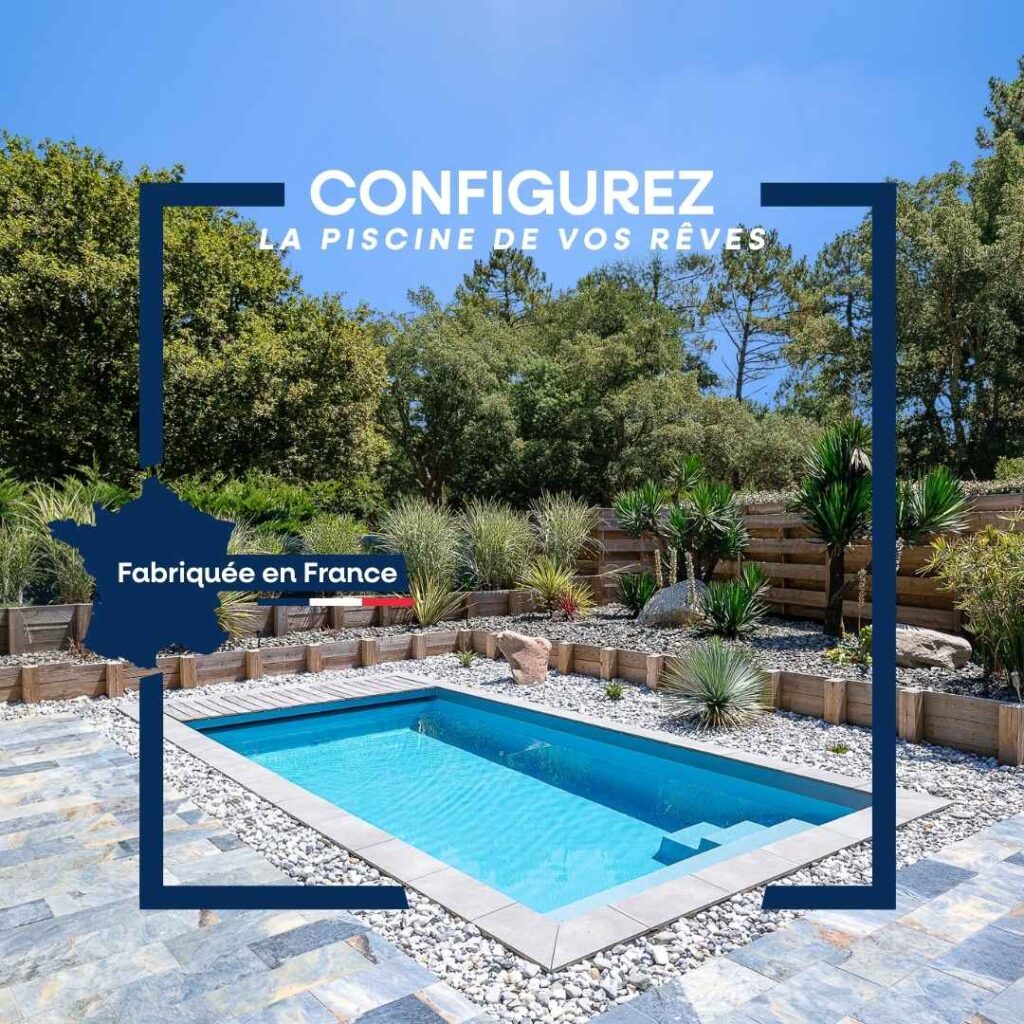
You have already chosen the dimensions of your future pool, perhaps even his color. But the depth? It's often the last decision, handled quickly, even though it's one of the most structuring. It determines the safety of your toddlers, the pleasure of adult swimming, and up to 20% of your annual energy consumption. Details that, over several years of use, can make a difference.
The good news: this choice is not complicated when you have the right benchmarks. Deep or shallow pool, sloping or flat bottom… Each option meets a specific usage profile.
This guide gives you the keys to choose the depth of your poolwith confidence, before the start of the construction site.
In summary:
- The standard depth of a family swimming pool varies between 1.20 m and 1.50 m: this is the most common and versatile configuration.
- There is no legally imposed depth for a private swimming pool in France, but safety recommendations strongly guide choices.
- Depth directly influences the volume of water, heating, and daily use of the pool.
- A gradual depth (from the shallow end to the deep end) offers a balanced solution for families with children of all ages.
Pool depth: what are the current standards and recommendations?
Contrary to what one might believe, there is no legally imposed minimum depth for a private swimming pool in France. The regulations primarily concern the mandatory safety devices (barrier, alarm, motorized cover, or enclosure) as soon as the pool is in-ground or semi-in-ground and accessible to children under 5 years old (law of January 3, 2003).
In practice, pool buildersprimarily rely on the family's actual usage (number of users, ages, swimming habits) before considering the technical constraints of the site. These benchmarks help define a consistent depth for your pool, without creating risks for users.
The table below summarizes the recommended depths according to the main uses:
| Main use | Recommended depth | Remarks |
|---|---|---|
| Family pool with young children | 0.80 m to 1 m | Shallow area on the staircase side strongly recommended |
| Adult/teen leisure swimming | 1.20 m to 1.54 m | The most common and versatile configuration |
| Sport swimming (freestyle, aquagym) | 1.40 m to 1.60 m | Constant depth along the entire recommended length |
| Dives (forward dive) | ≥ 1.80 m | This should be addressed as early as the design phase |
Constant depth or variable depth: which configuration to choose?
The choice between a flat bottom and a sloped bottom is one of the first decisions to make when designing a shell pool. These two pool architectures cater to different uses and have concrete implications for swimming comfort, the volume of water to manage, and the overall project cost.
The flat-bottom pool: simplicity and versatility
The flat-bottomed pool is the most common configuration for fiberglass shell pools. It offers a constant depth across the entire surface of the pool, generally between 1.30 m and 1.50 m.
This homogeneity offers several concrete advantages:
- optimal water circulation,
- easier cleaning thanks to pool robots,
- a uniform sense of volume for all swimmers,
- and a simpler shell structure to manufacture and install.
For a family with children over 10-12 years old, where the adults wish to swim or bathe comfortably, a flat-bottomed pool very often represents the best compromise between simplicity and efficiency.
The sloped-bottom pool: the balanced solution for families with children
The sloping bottom integrates two distinct areas: a small, shallow pool on the stair side (generally between 0.80 m and 1.00 m) which gradually deepens to a large pool at 1.40 m or 1.50 m. This configuration is particularly suitable for families with young children, as it allows the youngest to move safely in the shallow area while offering adults a comfortable swimming space.
The volume of water being slightly less than that of a flat-bottomed pool of the same dimensions mechanically reduces heating and water treatment costs.
What is the ideal depth according to the use and profile of your family?
Choosing the ideal depth for a swimming pool is above all about honestly answering a simple question: who will be swimming, and how? The answer varies considerably depending on the age of the users, their habits, and their expectations. Here are the main profiles and associated recommendations.
Family with young children: safety first
For families with children under 8 years old, the depth of the entry area is a priority safety criterion. A shallow pool from 0.80 m to 1.00 m allows children aged 6-8 to keep their footing and play with relative autonomy, under adult supervision.
Polyester shell pools allow for the integration of shallow ledges or submerged benches, creating a natural and reassuring transition between the edge of the pool and the swimming area.
It is one of the most requested configurations by families with young children who are preparing their project at Aboral Piscines.
Adults and leisure use: the comfort of classic bathing
For the vast majority of owners whose use is relaxation, family swimming, and a few occasional lengths, a depth of your pool between 1.30 m and 1.50 m represents the best option. At 1.50 m, an average-sized adult has their head above water, can swim crawl without risking touching the bottom, and benefits from a very appreciable feeling of freedom and space.
This is the reference depth found in the majority of projects supported by Aboral Piscines, as it adapts to all family members.
Sport swimming and aquagym: specific requirements
For owners who wish to swim regularly (freestyle, backstroke, aquagym), a constant depth of at least 1.40 m along the entire length of the pool is essential.
A long pool (10m or 12m) with a flat bottom and uniform depth will allow for comfortable swimming without having to adjust your trajectory according to depth variations.
Shell pools from Aboral Piscines allow for the design of custom-made pools precisely meeting these sporting uses, with adapted depth configurations. To learn more, contact the Aboral Piscines teams directly.
Seniors and people with reduced mobility
For older owners or those with reduced mobility, a shallow pool, between 1.30 m and 1.40 m, is often preferred, as it facilitates entry and exit from the pool and reduces apprehension related to depth.
In these projects, the staircase integrated into the hull and an intermediate landing (step at 0.60 m then at 1.00 m) become criteria as important as the depth itself.
Ideal depth and technical constraints: what your land imposes
The depth of a swimming pool: it is not only a functional or aesthetic choice: it is also conditioned by technical realities related to the terrain on which the swimming pool will be installed.
Thenature of the soilis the first factor to consider. Clayey or rocky soil can make earthworks significantly more difficult and expensive beyond 1.50 m in depth. Conversely, sandy soil or the presence of a high water table (frequent in Gironde, coastal areas, or alluvial plains) may require specific drainage systems to avoid any risk of uplift. These constraints are invisible to the naked eye but are crucial for thedurability of the installation.
The natural slope of the land also plays a role. A pool on a slightly sloped lot can help optimize the apparent depth on the high side while limiting the excavation volume, which reduces construction costs.
Pool depth and water volume: what impact on operating costs?
The depth is directly linked to volume of water in the basin, and the volume of water conditions a large part of the annual operating costs: heating, chemical treatment, water consumption during filling.
The basic calculation is simple: water volume = length × width × average depth. For an 8×4 m pool, each additional tenth of a meter in depth represents about 3.2 m³ more water. These differences can be significant when filling the pool or heating the water:
| Average depth | Volume (8x4 m pool) | Estimated filling cost* | Estimated heating cost/year* |
|---|---|---|---|
| 1.20 m | ≈ 38 m³ | ≈ 160 € | ≈ 380 – 600 € |
| 1.40 m | ≈ 45 m³ | ≈ 188 € | ≈ 450 – 700 € |
| 1.60 m | ≈ 51 m³ | ≈ 215 € | ≈ 510 – 800 € |
* Indicative estimates, excluding heat pump, according to water and energy tariffs 2025-2026.
Choosing the ideal depth for a swimming pool ultimately means balancing several factors: the safety of younger children and the comfort of adults, the pleasure of swimming and the control of operating costs, the family's desires and the realities of the terrain. There is no universal depth, but there is a right depth for each project, provided it is identified methodically.
If you wish to move forward concretely with your thinking, the Aboral Piscines teams are available to help you define the configuration best suited to your situation.
Share this article

You may be asking yourself these questions?
The ideal depth for a family pool is between 1.30 m and 1.50 m. This is the most versatile configuration, suitable for adults and teenagers.
Yes. A sloped bottom incorporates a small pool at 0.80 m-1.00 m on the staircase side. Polyester shell pools allow for these configurations directly within the shell structure.
No, no minimum depth is legally imposed for private swimming pools. The law concerns mandatory safety equipment (fence, alarm, cover, or enclosure).
Yes, because the volume of water is greater. Every additional 10 cm on an 8x4 pool represents about 3.2 m³ more water, with a direct impact on heating and treatment costs.
Not directly. The development tax is calculated on the ground area, not the depth. The property tax depends on the overall cadastral rental value of the property.
On the same topic
Your fiberglass pool project is waiting for you!
Configure your shell pool in just a few clicks or find your nearest Aboral distributor for personalized support from start to finish.