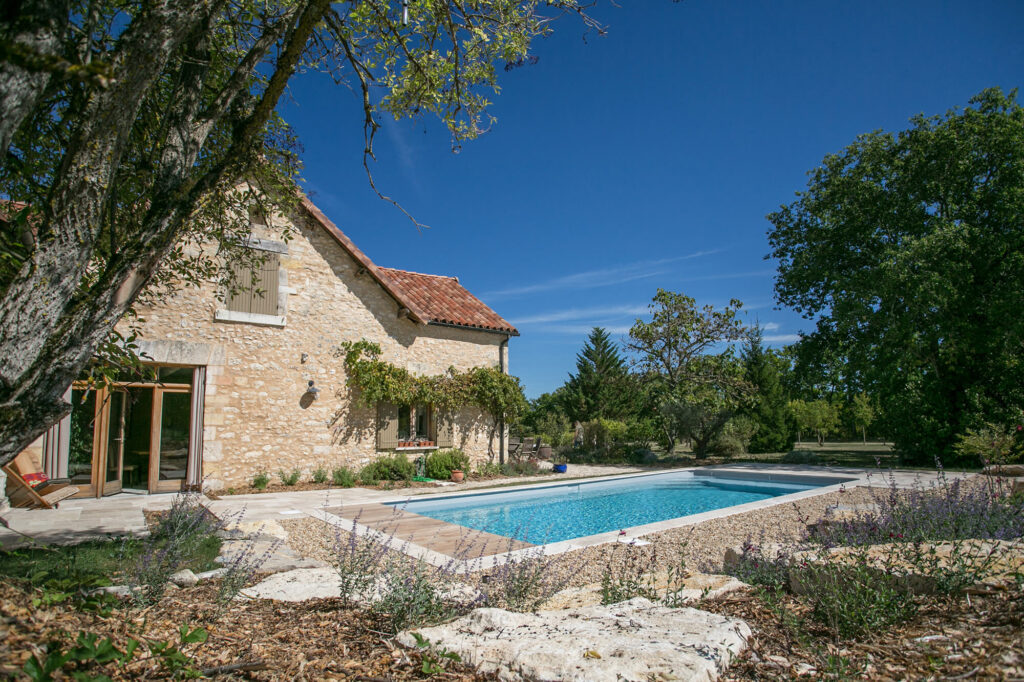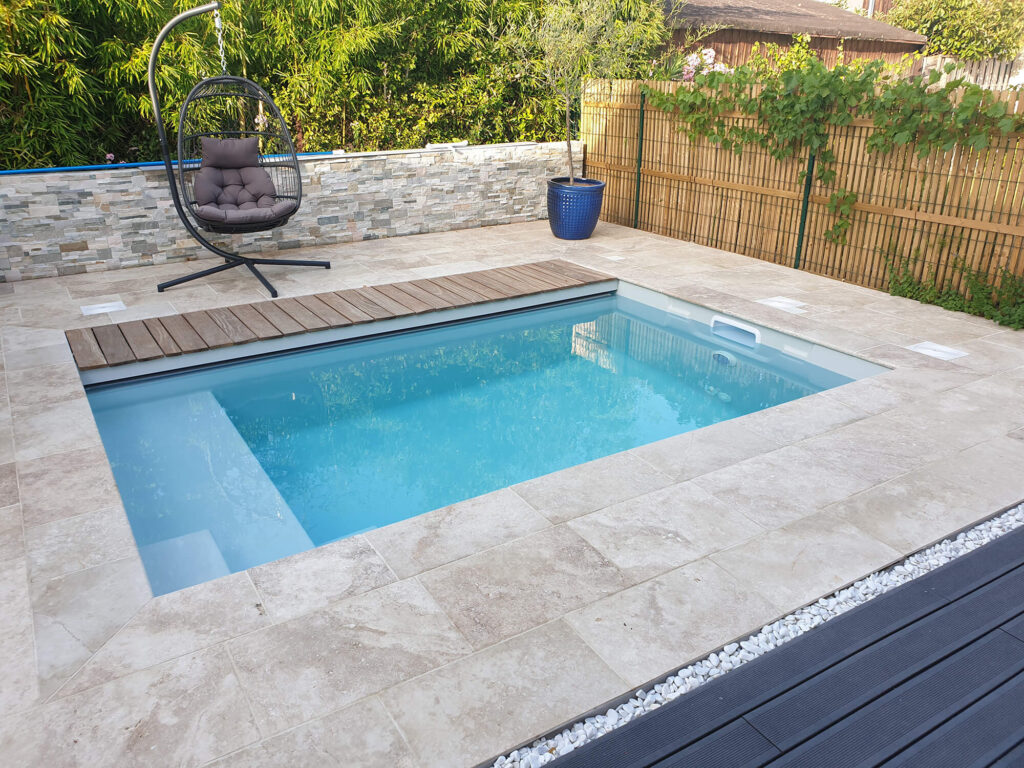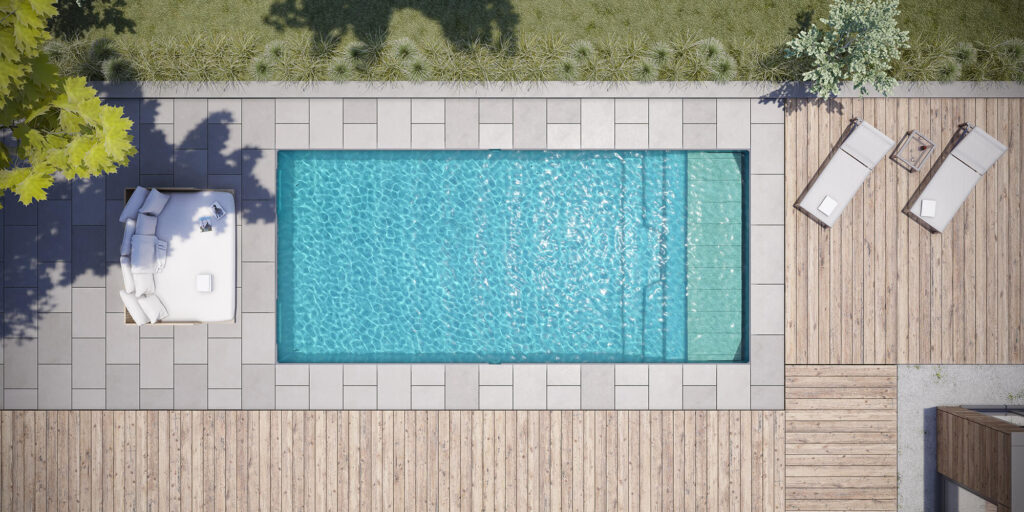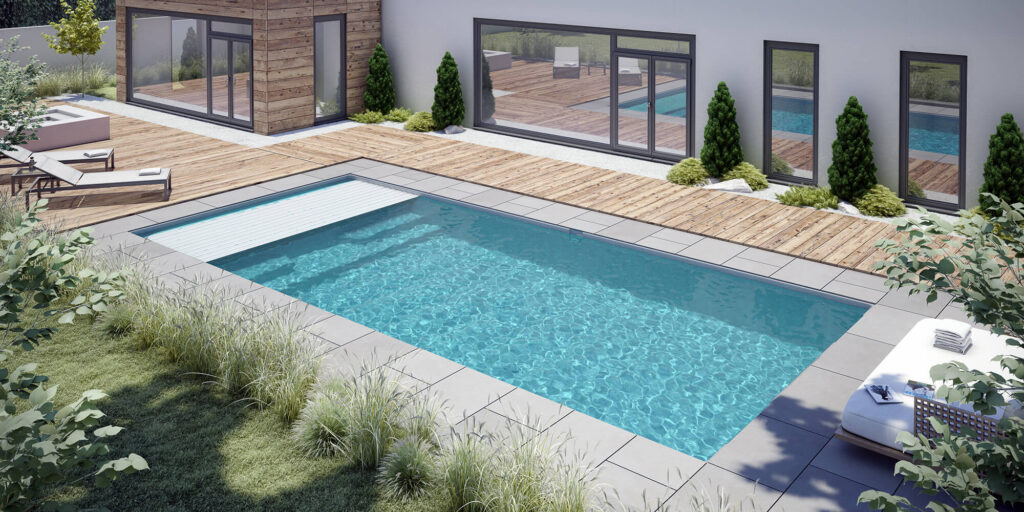
For many homeowners, building a swimming pool (in-ground or semi-inground) represents a real improvement in their quality of life: more time spent at home, different summers, a garden that takes on a new dimension. The only obstacle, in many cases, is the pool budget.
With an overall cost generally ranging from €7,000 to €25,000, the idea of taking out a 180-month (15-year) pool loan is becoming increasingly appealing. Lower monthly payments, the possibility of starting the project without using up all your savings, and above all, the pleasure of enjoying your pool today, rather than putting the project off until later.
Like any financing solution, this option deserves careful consideration. What is its real impact on the long-term budget? And above all, in what cases is it a sensible choice for financing a fiberglass pool? ?
In summary:
- In France, home improvement loans or personal loans are generally limited to 7–10 years.
- Financing over 15 years is only possible in certain cases, particularly through a mortgage refinancing, subject to strict conditions.
- Lower monthly payments mean higher total costs: before making a decision, it is essential to compare the term, interest rate, and overall cost of the loan.
What is the maximum legal term for a pool loan in France?
Let's start with an essential point that is often misunderstood: in France, financing a swimming pool through a dedicated loan is legally considered a consumer loan, just like a home improvement loan or a personal loan.
As such, the repayment period is strictly regulated. For a pool loan classified as consumer credit, the terms offered by banks generally range from 84 to 120 months, or a maximum of 7 to 10 years.
This limit is not a coincidence. It is based on two considerations:
- Protecting the borrower against excessive long-term debt on a recreational property,
- Limit the risk for banking institutions, which have no real estate collateral on this type of loan.
Can you finance a swimming pool over 180 months in France?
Spreading the cost of a swimming pool over a long period, such as 180 months (15 years), may seem attractive at first glance, particularly as it reduces the monthly payments. However, this is not possible with a traditional consumer loan. The only way to achieve such a long repayment period is to mortgage refinancing package. This involves:
- have an existing mortgage,
- to include the cost of the swimming pool project in this loan,
- and that the mortgage represents at least 60% of the total amount borrowed.
In this context, it becomes possible to extend the repayment period to up to 15 years, while generally benefiting from a lower interest rate than that of a consumer loan. This option may be relevant for households that already own property, subject to bank eligibility.
Comparison of pool financing solutions
| Type of financing | Maximum duration | Interest rate 2026* | Accessibility |
| Traditional consumer credit | 120 months | 6,5% – 7,5% | Very easy |
| Mortgage refinancing | 180+ months | 3,5% – 5% | Strict conditions (60%) |
Please note: Before committing, it is strongly recommended that you perform an online simulation to verify the feasibility of the project in terms of your repayment capacity.
Case study: 8×4 m shell pool, project costing €35,000
Let's take an example: Mr. Michu has a project for 8×4 fiberglass pool standard equipment and basic fittings.
- Total project budget: 35 000 €
- Personal contribution: 5 000 €
- Amount to be financed: 30 000 €
Now let's see what this means in concrete terms for his budget, depending on the financing plan chosen:
| Type of financing | Duration | APR | Monthly payment | Total cost of credit | Total reimbursed |
| Traditional home improvement loan | 120 months (10 years) | 7,10 % | 342 € | 11 040 € | 41 040 € |
| Mortgage refinancing | 180 months (15 years) | 4,85 % | 227 € | 10 860 € | 40 860 € |
An 15-year swimming pool loan may be interesting only if it is backed by a existing mortgage, with a lower rate. In this case, the monthly payment amount decreases without excessively increasing the total cost.
To make the right choice, it is therefore essential to look at the total cost of the loan and the APR, and not just the monthly payment.
Advantages of a 180-month pool loan: when does it make sense?
Lower monthly payments to keep your budget balanced
The main advantage of financing a pool over 15 years is simple: lower monthly payments. In our credit simulations, switching from a 10-year loan to 15-year financing reduces the monthly payment by approximately $115 per month. Over the course of a year, this represents more than $1,300 in budget flexibility.
For certain profiles, this flexibility can really make the difference between a feasible project and a postponed project.
Only worthwhile in the case of mortgage refinancing
This is the only scenario in which a 180-month pool loan be financially viable. When included in a mortgage refinancing package, the financing benefits from a significantly lower interest rate than a traditional home improvement loan.
Result: one reduced overall installment; a controlled total cost, and simplified management with a single loan and a single insurance policy. Another often underestimated advantage: debt consolidation can improve your debt ratio apparent, which preserves your borrowing capacity for other future projects.
The disadvantages of a 180-month pool loan: what you really need to consider
A significantly higher total cost over time
This is the main point to bear in mind. Extending the term of a loan automatically increases its total cost, even if the monthly payments seem more manageable. Over 15 years, the cumulative interest can amount to several tens of percent of the amount borrowed.
In addition, during this entire period, your borrowing capacity remains impaired. This can complicate:
- The purchase or replacement of a vehicle,
- Home improvement projects,
- Financing children's education,
- Or a future real estate project.
Even if the monthly payment is moderate, it puts a lasting strain on your budget and reduces your financial flexibility.
A risk in the event of a change in circumstances
The average length of ownership of a primary residence in France is approximately 7 to 8 years. If the property is sold before the end of the loan term, the outstanding capital must be repaid in full. However, the added value provided by a swimming pool does not always cover the amount still to be repaid, especially on a long-term loan.
In some cases, this may lead to mobilizing savings or incurring additional costs at the time of sale.
What are the alternatives to a 180-month loan?
The traditional home improvement loan over 7 to 10 years
In most cases, a 7- to 10-year pool renovation loan is the ideal solution for many homeowners. Let's return to our example with a €30,000 loan:
| Duration | Indicative rate | Monthly payment | Total cost of credit | Total reimbursed |
| 7 years (84 months) | 6,2 % | 436 € | 6 624 € | 36 624 € |
| 10 years (120 months) | 6,5 % | 342 € | 11 040 € | 41 040 € |
Admittedly, the monthly payments are higher than with a 15-year loan. But the difference should be put into perspective: you save between €10,000 and €15,000 in interest compared to a long-term loan. For a swimming pool project, that's a major difference.
Another often underestimated advantage is that rates are more attractive for shorter terms. Banks consider the risk to be lower and generally offer rates between 5.5% and 6.8% for 7 to 10 years, compared to 7.5% to 8.5% for longer terms.
Finally, a shorter loan term frees up your borrowing capacity more quickly. After 7 or 10 years, your pool loan will be paid off, allowing you to consider other projects without constraints.
Loans with a personal contribution: the most effective strategy
This is often the simplest solution... and the most cost-effective. Reducing the amount borrowed remains the most effective way to lower the total cost of credit.
For a €35,000 project, let's compare two scenarios:
| Scenario | Amount borrowed | Duration | Monthly payment | Cost of credit |
| Limited contribution | 30 000 € | 10 years | 342 € | 11 040 € |
| Enhanced contribution | 20 000 € | 10 years | 226 € | 7 120 € |
By contributing an additional €10,000, you save €3,920 in interest. In other words, your contribution generates an implicit "return" of nearly 40% over 10 years, without any risk.
Even if it delays the project by a few months, the long-term financial gain more than compensates for the wait.
Aboral Piscines supports you from start to finish in your project.
For over 30 years, Aboral Piscines supports private customers in the realization of their polyester shell pool projects all over France.
Each project begins with a transparent approach : a precise cost estimate that includes all items, a realistic estimate of the overall budget and, where necessary, consideration of the financing options suited to your situation.
The goal is simple: to secure your investment and allow you to move forward with peace of mind, taking into account your situation and your future plans.
If you want to move forward with confidence in your pool project, we are here to support you every step of the way.
FAQ – 180-month pool loan
- Can you take out a 180-month loan for a swimming pool?
A 180-month pool loan is possible through a mortgage refinancing (provided that the mortgage represents at least 60% of the total amount). However, a traditional consumer loan is limited to a maximum of 120 months.
- What is the difference in cost between a 10-year and a 15-year pool loan?
For a loan of €30,000, the interest cost is approximately €11,000 over 10 years at 6.5%, compared to €22,000 over 15 years at 7.8%. The monthly payment decreases (approximately $227 compared to $342), but the total cost of the loan increases significantly, with nearly $11,000 more to pay.
- Is mortgage refinancing mandatory in order to spread payments over 15 years?
It is not mandatory, but it is the only truly financially viable solution.
- Is a personal contribution required to finance a swimming pool?
No, a down payment is not mandatory. However, a down payment of 10 to 20% significantly improves borrowing conditions: lower interest rates, reduced monthly payments, and faster approval. On a €30,000 loan, a €6,000 down payment saves you around €2,500 in interest over 10 years.
- Is borrower insurance mandatory for a pool loan?
Yes, for any loan exceeding €15,000, borrower insurance is systematically required. It covers the risks of death, disability, or job loss. Its cost is generally between 0.30% and 0.50% of the principal per year, or €90 to €150 per year for a €30,000 loan.
Configure your pool online Back to all news