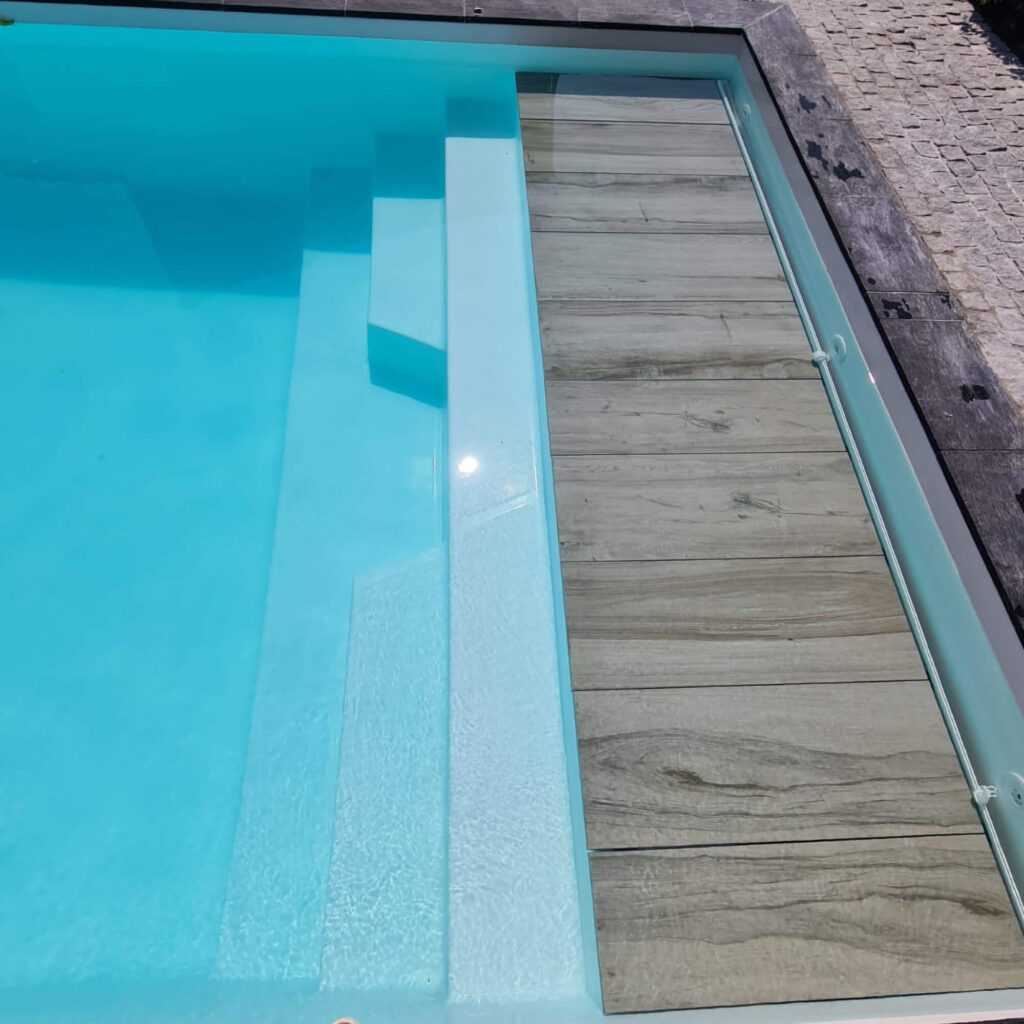
In France, the saltwater pool is attracting more and more homeowners who want to combine swimming comfort, practicality, and environmental friendliness. Long reserved for high-end pools, this solution is becoming more widely available thanks to more accessible and efficient water treatment systems that are more accessible and efficient.
But before opting for this type of installation, an essential question arises: what are the real advantages and disadvantages of salt treatment ? Aboral Piscines offers you a comprehensive overview of comfort, costs, and maintenance to help you make the right choice.
How does a saltwater pool work?
Contrary to popular belief, a saltwater pool is not a "chlorine-free" pool. It is based on a well-known principle: salt electrolysis.
In practical terms, a small amount of salt is added to the pool water (usually between 2.5 and 4 grams per liter, which is about 9 times less than in seawater). This salt is then transformed by electrolysis : thanks to electric currents applied in the salt electrolyzer, the ions contained in the water are transformed into natural chlorine.
This process allows produce chlorine automatically, continuously, ensuring effective disinfection without the need to regularly add chemicals. Once its disinfecting role is complete, the chlorine reverts back to salt in the water, and the cycle begins again.
It is therefore a closed-loop water treatment system. closed-loop water treatment system, which limits manual intervention and ensures more consistent water quality.
The advantages of a salt pool
1. Swimming comfort
The first advantage of a saltwater pool is the comfort you feel when swimming. And for good reason:salt water is gentler on the skin and eyes because it does not contain excess chemical stabilizers. It prevents skin irritation and allergies sometimes caused by chlorine.
In addition, the characteristic smell of chlorine disappears, making the experience much more pleasant.
This makes it an ideal solution for families, especially if children swim regularly.
2. A more natural and environmentally friendly solution
With salt treatment, the use of chemicals is significantly reduced. Salt is naturally present on Earth and is a simple, non-toxic, and recyclable element.
Furthermore, unlike a pool treated only with liquid or tablet chlorine, a saltwater pool produces its own disinfectant through electrolysis. This process limits the environmental impact and reduces the user's handling of chemicals.
3. Long-term savings
Even if theinitial investment is higher, a saltwater pool becomes attractive in the long term. There are several reasons for this:
- Salt costs much less than conventional chemicals.
- The transformation cycle (salt → chlorine → salt) means that the amount of salt to be added is small and only needs to be replenished rarely.
- The automatic treatment system reduces the consumption of chemical correctors, provided that a good pH regulator to stabilize the pH level.
Over several years, owners have noticed a significant decrease in maintenance costs.
4. Simplified maintenance
A saltwater pool is easier to maintain than a traditional pool:
- Thesalt chlorinator takes care of chlorine production without manual intervention.
- The filtration system and electrolysis ensure that the water is continuously disinfected.
- Simply check the salt level in the water and the pH level, and check that the cell is working properly.
To optimize the life of the equipment, it is necessary to clean the cell of the electrolyzer regularly the electrolyzer cell, but this operation is not very demanding compared to the frequent handling required for conventional chlorine treatment.
Salt treatment for swimming pools: the disadvantages you should be aware of
1. Higher installation costs
The main disadvantage of salt treatment is its initial investment.
- The purchase and installation of a salt chlorinator represents an additional expense.
- Certain equipment such as pH regulators or hydrolysis systems may be necessary to ensure balanced water.
Thus, a saltwater pool costs more initially than a traditional chlorine pool.
2. Risks of corrosion
Saltwatersalt water can be detrimental to certain materials:
- Risk of corrosion of metal parts (ladder, screws, spotlights).
- Weakening of certain liners if the salt level is not properly controlled.
However, proper installation and maintenance can limit this risk.
How much does a saltwater pool cost?
The price of a saltwater pool varies depending on several factors:
- Price of thesalt chlorinator : between €800 and €2,000 depending on power.
- Cost of a pH regulator : between €400 and €1,000.
- Labor for installation.
Over a period of 5 to 10 years, the savings achieved thanks to the low cost of salt and the reduction in chlorine purchases more than offset the initial investment.
Saltwater pool or chlorine pool: which to choose?
To help you make an informed choice, here is a comparison of the two treatment systems:
| Criterion | Saltwater pool | Chlorine pool |
| Comfortable swimming | Fresh water, no odor or irritation | Strong odor, possible irritation |
| Initial investment | Higher (electrolyzer, pH regulator) | Less expensive |
| Long-term cost | More economical (inexpensive salt) | Regular purchase of chemicals |
| Interview | Automated, some controls | Manual, frequent addition of products |
| Sustainability | Closed treatment cycle, low replenishment | Depends on frequency of use |
In summary:
- If you are looking for simplicity and comfort when swimming, a saltwater pool is an excellent choice.
- If you prefer a low budget in the short term, chlorine remains more affordable.
The opinion of Aboral Piscines, manufacturer of polyester shell pools
At Aboral Piscines, we have been supporting our customers for over 30 years in the design and installation of polyester shell pools tailored to their desires. Our models are compatible with salt treatment , and we advise each future owner on choosing the solution best suited to their lifestyle.
We particularly recommend salt treatment for families looking for optimal swimming comfort and simplified long-term management. Our teams will also assist you in choosing the treatment system, pH regulator, and filtration system configuration.
Request a personalized quote and discover our models of shell pools designed to last.
Configure your pool online Back to all news