What distance should be maintained between a swimming pool and the neighbor's fence?
Written by:
Modified on:
Reading time:
Article outline
- Why is the distance between your pool and the neighbor's fence regulated by law?
- What is the mandatory minimum distance between a swimming pool and the neighbor's fence?
- What are the consequences of a pool built too close to the neighbor's fence?
- What type of urban planning permit must be filed to build a swimming pool?
- Aboral Piscines' tailor-made support: from the cadastral plan to installation
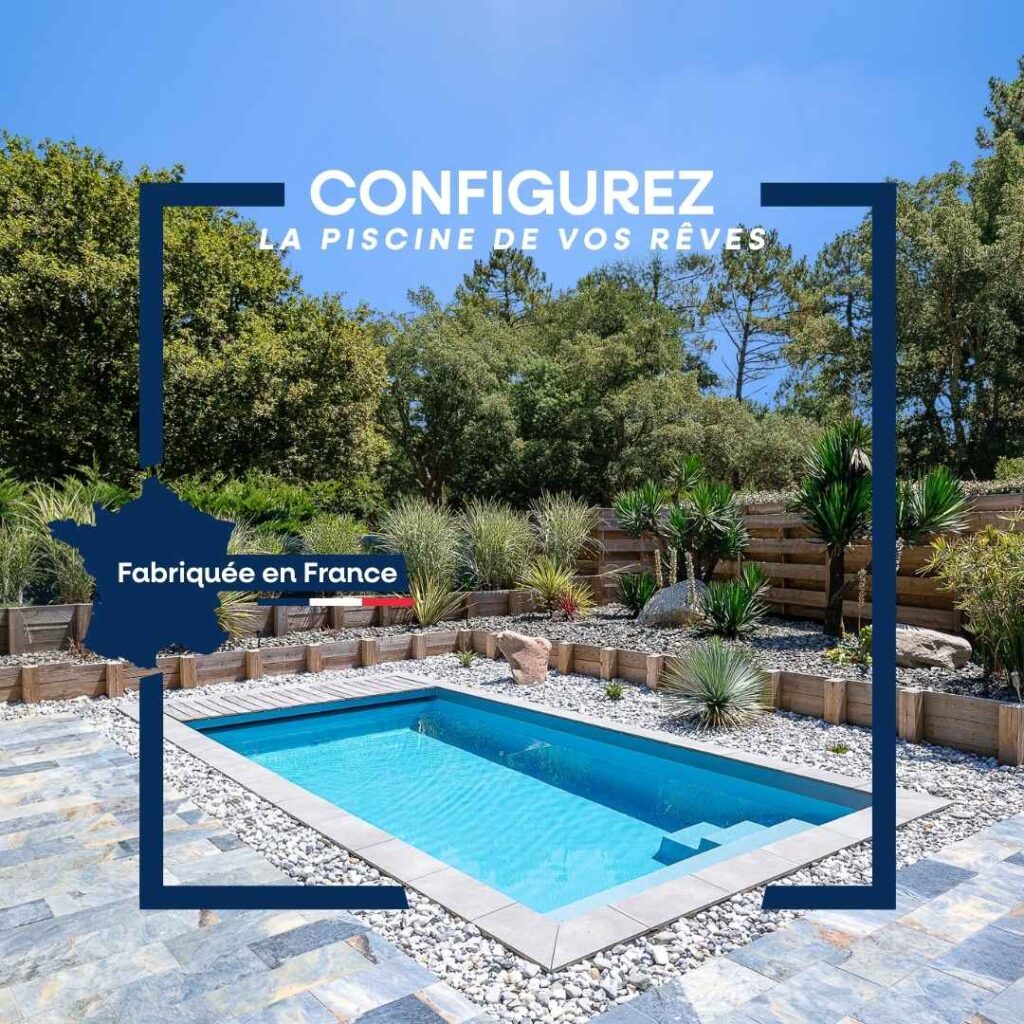
Building a swimming pool means transforming your garden into a real living space. For this project to be completed under the best conditions, a few urban planning rules are worth knowing from the start, starting with the distance to be respected between the pool and the neighbor's fence. These rules, far from being an obstacle, are valuable guidelines that secure your swimming pool construction project in the long term.
The minimum distance of 3 meters from boundary lines constitutes the general framework, but your municipality may provide for specific rules in its Local Urban Plan.
Without further ado, here are all the keys to checking the applicable rules for your land and designing a compliant, serene, and perfectly adapted layout for your garden.
In summary:
- The minimum distance of 3 meters between the fence and the pool applies by default throughout France via the RNU.
- Your Local Urban Plan (PLU) can modify this distance: always check your municipality's regulations before starting your project.
- A pool too close to the neighbor's fence can lead to a permit refusal, legal action, or block a future property sale.
- Professional support from the design phase onwards optimizes the placement of the pool while respecting urban planning regulations.
Why is the distance between your pool and the neighbor's fence regulated by law?
The distance between a swimming pool and the neighbor's fence is governed by two distinct texts: the Urban Planning Code, which sets setback rules to ensure sanitation, sunlight, and good cohabitation between neighboring owners, and the Civil Code, which protects rights of view and penalizes abnormal neighborhood disturbances. A poorly positioned pool, too close to a boundary line, can lead to real nuisances that your neighbor is entitled to contest.
Before positioning your pool, it is also important to distinguish the physical fence (wall, hedge, wire mesh) from the cadastral boundary line. These two lines do not always coincide, and it is the cadastral boundary that is authoritative with urban planning services.
You can consult it for free on cadastre.gouv.fr even before drawing your first site plan.
What is the mandatory minimum distance between a swimming pool and the neighbor's fence?
The general rule requires a minimum distance of 3 meters between the edge of your pool and the property lines of your land. However, depending on where you live, this distance may vary.
The 3-meter rule: what the National Urban Planning Regulations (RNU) say
The RNU, National Urban Planning Regulations, applies by default in all municipalities that do not have a Local Urban Plan (PLU) or a Land Use Plan (POS).
Article R. 111-19 of the French Urban Planning Code requires a minimum distance of 3 meters between any construction (including in-ground and semi-in-ground swimming pools) and the property boundaries. This rule therefore applies in the absence of a more specific local document, which still concerns a significant number of French rural municipalities.
What your Local Urban Plan (PLU) can modify
As soon as a municipality has a Local Urban Plan or a land use plan, this document takes precedence. The PLU may impose distances greater than the national standard (4, 5, or sometimes 6 meters), particularly in dense residential areas or near protected sectors. Conversely, some PLUs expressly authorize the construction of a swimming pool on the property line, provided that the above-ground height remains zero or almost zero, as is often the case for an in-ground swimming pool.
Consulting the zoning regulations applicable to your plot is therefore an essential step, to be carried out on the Géoportail de l’urbanisme or directly at the town hall.
| Situation of the municipality | Minimum applicable distance | Reference document |
|---|---|---|
| Municipality with a local urban plan | Variable (often 3 to 6 m) | PLU / zoning regulations |
| Municipality without a local urban plan (RNU) | 3 meters minimum | Urban planning code (Art. R. 111-19) |
| Protected area or PPRI | Reinforced distances | PLU + special regulations |
| PLU agreement at property line | 0 meters possible under conditions | Municipal zoning plan only |
What are the consequences of a pool built too close to the neighbor's fence?
Trimming a few centimeters off the regulatory distance to gain a little space in the pool may be tempting. But the consequences of non-compliant installation can last much longer than the work itself.
Neighborhood disputes and civil remedies
A neighbor who believes their privacy, sunlight, or enjoyment of their garden is affected by your swimming pool can bring the matter before the judicial court.
Based on Article 544 of the Civil Code and the rules on abnormal neighborhood disturbances, a judge can order restoration, specifically the relocation of the pool, and award damages.
This type of procedure is long, trying, and rarely beneficial for both parties.
Administrative sanctions and risks during resale
It is often at the time of sale that the problem arises. The notary is required to verify the conformity of all constructions with the authorizations obtained.
A swimming pool outside legal distances can block the transaction or force an urgent regularization. The Town Planning Code also provides for fines that can reach 6,000 euros per square meter built illegally, a sum that quickly puts into perspective the gain in surface area initially sought.
The statute of limitations: are you protected over time?
One might think that a pool that has been in place for several years is definitively safe. This is not always the case.
Urban planning offenses are subject to a 10-year statute of limitations. A non-compliant swimming pool installed in 2025 is therefore challengeable until 2035. Civil actions between neighbors, on the other hand, have a 5-year statute of limitations from the time the facts become known.
A change of neighbor or a sale of the property is sometimes enough to reopen a case that was thought to be closed.
What type of urban planning permit must be filed to build a swimming pool?
The distance between the pool and the neighbor is not the only point to anticipate before starting the work. The installation of a swimming pool requires, in most cases, a town planning permit, and the type of file to be submitted depends primarily on the size of the pool.
Prior declaration of works: when does it apply?
For the vast majority of projects, it is the prior declaration of works that applies. It concerns all uncovered swimming pools with a surface area between 10 m² and 100 m².
The file is relatively simple to assemble: it includes, in particular, a site plan indicating precisely the distances to the boundary lines. The processing time at the town hall is generally one month.
To give a concrete example, an 8x4 m shell pool represents 32 m². It therefore falls under prior declaration, not a building permit. This is the case for the vast majority of pool projects for individuals.
When is planning permission required?
The building permit comes into play in two main situations: when the pool surface area exceeds 100 m², or when the pool is covered by a fixed shelter, considered a construction in its own right.
Protected areas constitute a special case. Within the perimeter of a historic monument or in an area subject to an Flood Risk Prevention Plan, a building permit may be required regardless of the pond's surface area. The processing times are also longer there.
Aboral Piscines' tailor-made support: from the cadastral plan to installation
Surrounding yourself with the right contacts makes all the difference, especially on regulatory matters. At Aboral Piscines, support includes a preliminary analysis of the cadastral plan, the applicable local urban plan (PLU), and the specific characteristics of the land, to design a compliant and optimized layout right from the design phase.
The diversity of fiberglass shell pool models allows for a solution adapted to every garden configuration, without compromising on quality or aesthetics. Each pool is designed to integrate durably into its environment.
With over 30 years of experience with individuals, Aboral Piscines assists you in building your administrative file, manages site coordination and post-installation follow-up, from A to Z.
When properly understood, the rules governing the installation of a swimming pool are not obstacles: they are guidelines that secure your project in the long term. Whether you are in a PLU zone, subject to RNU, or in a municipality with specific rules, the essential thing is to check the regulations applicable to your plot before positioning your pool.
A well-prepared swimming pool project beforehand means a smooth construction site and a result you'll enjoy for years to come.
Would you like to check thefeasibility of your setup? Contact Aboral Piscinesfor a personalized, no-obligation initial discussion.
Share this article

You may be asking yourself these questions?
In the absence of a PLU, the RNU requires a minimum of 3 meters between the pool and property lines. Your municipality may specify a different distance in its PLU: always check before starting your pool project.
Yes, under certain conditions. Some municipal PLUs authorize it for in-ground pools with edges flush with the ground. A verbal agreement with the neighbor is not sufficient to override urban planning regulations.
If your project complies with urban planning rules and legal distances, your neighbor cannot block it directly. They have 2 months after the permit is posted to file an appeal.
A 32 m² swimming pool requires a prior declaration of works. A building permit is only required for pools over 100 m² or for a pool covered by a fixed shelter.
Consult your municipality's Local Urban Plan (PLU) on the Urban Planning Geoportal or at the town hall. In the absence of a PLU, the RNU applies: 3 meters minimum. A professional can carry out this check for you.
On the same topic
Your fiberglass pool project is waiting for you!
Configure your shell pool in just a few clicks or find your nearest Aboral distributor for personalized support from start to finish.