Everything you need to know about financing your pool
Written by:
Modified on:
Reading time:
Article outline
- What is the actual budget required to finance a fiberglass pool?
- What are the main financing solutions for a swimming pool?
- Home improvement loan or debt consolidation: which solution should you choose?
- Is there any government assistance available to help finance a swimming pool?
- Aboral Piscines supports you in your financing project
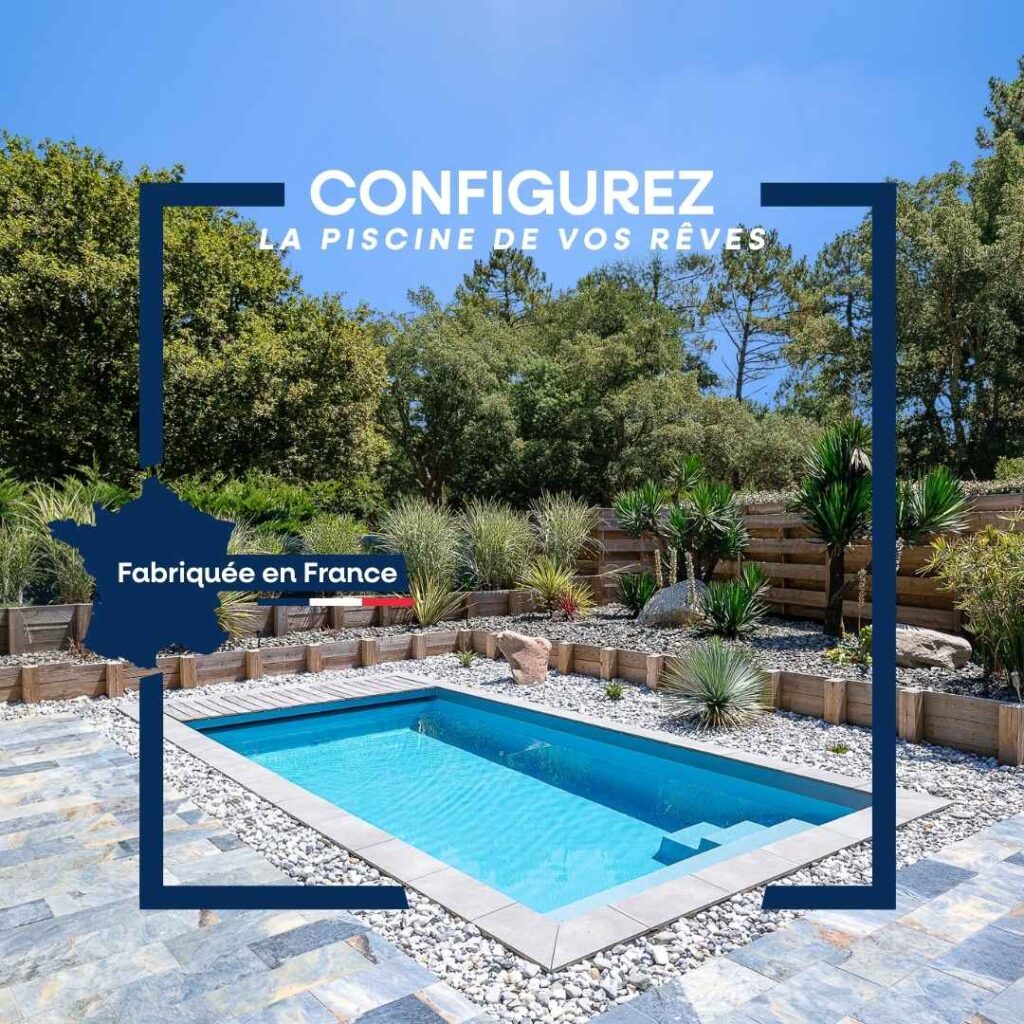
Installing a pool in your garden is much more than just a landscaping project: it's a real life project that will transform your daily life for years to come. Summer mornings by the water, moments of shared conviviality, a garden that takes on a new dimension... The benefits are immediate and lasting.
However, one question keeps coming up among property owners: how can they finance this investment with peace of mind?
With a total budget generally ranging from €15,000 to €35,000 for an in-ground pool with equipment, the financial aspect of the project warrants careful consideration. Between pool loan, personal contributions, mortgage refinancing, and government subsidies, there are several financing options available.
An overview of the different options available to you for financing your swimming pool.
In summary:
- A swimming pool is usually financed through a home improvement loan (7-10 years) or a mortgage refinancing (up to 15 years).
- A down payment significantly reduces the total cost of the loan and improves borrowing terms.
- Government subsidies remain limited but can reduce the investment required for environmentally friendly equipment.
- Anticipating all costs (construction, taxes, maintenance) allows you to establish a realistic budget.

What is the actual budget required to finance a fiberglass pool?
The price of the pool according to its dimensions
Before choosing a financing solution, it is essential to accurately determine the total amount required. Many homeowners make the mistake of only considering the price of the shell, without taking into account all the items that make up a complete project. This partial view can lead to financial dead ends or last-minute compromises that compromise the final quality of the installation.
The price of a polyester shell pool varies mainly according to its the dimensions or :
- For a 6×3 m pool, expect to pay between €15,000 and €22,000, including installation.
- An 8×4 m swimming pool generally costs between €20,000 and €30,000.
- For large models measuring 10×5 m, the budget starts at around €30,000 and can reach €40,000 depending on the equipment chosen.
Additional work and equipment
But the budget doesn't stop there:
- The earthworks represent between €2,000 and €5,000 depending on the terrain configuration.
- Electrical and hydraulic connections add €1,500 to €3,000.
- Copper pipes are used to connect the drain to the sewer.
- Finally, mandatory safety equipment adds €1,500 to €8,000.
Beyond the initial investment, additional costs must be anticipated:
- The development tax is generally between €200 and €800 for a standard swimming pool.
- The property tax is generally between €200 and €400 per year, depending on your location.
- Home insurance premiums are rising by €50 to €150 per year.
These factors must be incorporated into your overall financial planning.
Let's take a concrete example:
Mr. and Mrs. Dubois want to install an 8×4 m swimming pool. Here are the expenses they will need to consider when planning their pool project:
| Nature of the cost | Expense item | Amount |
|---|---|---|
| Investment | Shell with installation | 18 500 € |
| Connections | Water and electrical networks | 2 500 € |
| Construction work | Excavation | 3 200 € |
| Finishes | Coping | 2 800 € |
| Equipment | Filtration & heating | 4 500 € |
| Safety | Automatic shutter | 6 500 € |
| Taxation | Development tax | 400 € |
| Total | 38 400 € | |
What are the main financing solutions for a swimming pool?
For financing a swimming pool. Each option has its own characteristics in terms of duration, interest rates , and total cost. The choice depends primarily on your situation: do you have an existing mortgage? What is your current debt ratio? What monthly payment can you afford?
Traditional home improvement loan (consumer credit)
The personal loan dedicated to work constitutes the most common solution. This type of credit allows borrowing up to €75,000 over 7 to 10 years (84 to 120 months). The interest rates are between 6.5% and 7.5% in 2026.
Advantages? No mortgage required, quick process, obtained within a few days to a few weeks.
On a loan of €30,000 at 6.5% over 10 years, you will repay a total of approximately €41,000, or €11,000 in interest, with a monthly payment of €342. Over 7 years at 6.2%, the monthly payment rises to $436, but the interest cost drops to $6,600. This difference of $4,400 illustrates the importance of looking at the total cost, not just the monthly payment.
Mortgage refinancing
For homeowners who already have a mortgage, refinancing can be a very attractive option. The principle is to incorporate the cost of swimming pool project into your existing mortgage, taking advantage of more favorable interest rates (3.5% to 5%).
This operation allows the loan term to up to 180 months, reducing the overall monthly payment.
Good to know:
The mortgage must represent at least 60% of the total amount borrowed after refinancing. If you want to include a $30,000 pool loan, your mortgage must have a minimum outstanding balance of $45,000.
Personal contribution: the most effective strategy
Reducing the amount borrowed remains the most powerful lever for controlling overall costs. Every euro not borrowed avoids generating interest for 7, 10, or 15 years. On a €35,000 project, a contribution of €10,000 (30% of the project) reduces the loan to €25,000. At 6.5% over 10 years, the monthly payment falls to $285 and the interest cost to $9,200, compared to $14,500 without a down payment. You save more than $5,000.
Thepersonal contribution also improve your borrowing conditions. Banks consider a file with a down payment to be more solid, which translates into more advantageous rates, faster acceptance, and easier negotiation.
Home improvement loan or debt consolidation: which solution should you choose?
The answer depends primarily on your current financial situation. Let's look at two practical examples that represent the most common situations.
Case No. 1: Couple without a mortgage
Mr. and Mrs. Martin paid off their mortgage two years ago.
Their project: an 8×4 m swimming pool for €32,000. With a down payment of €7,000, they borrow €25,000. A home improvement loan is the obvious choice.
Over 10 years at 6.5%, their monthly payment is €285 for a total loan cost of €9,200. This monthly payment remains comfortable and the term preserves their financial flexibility.
Case No. 2: Owner with outstanding loan
Mrs. Lefèvre is paying off a mortgage of €120,000 (outstanding principal) over 20 years, with monthly payments of €680. She would like to buy a swimming pool for €30,000.
- Option 1: standard pool loan at 6.8% over 10 years, additional monthly payment of €345, total monthly payment of €1,025.
- Option 2: credit consolidation. New credit of €150,000 over 21 years at 4.2%, single monthly payment of €795. She saves €230 per month despite processing fee of €1,800.
At Aboral Piscines, we support our customers in this process by providing accurate cost estimates that facilitate banking procedures and quickly provide visibility on the financing options available.
Is there any government assistance available to help finance a swimming pool?
The assistive devices are relatively limited for swimming pools, unlike energy renovation work. Nevertheless, some opportunities are worth exploring, especially if your project integrates ecological equipment.
The zero-interest eco-loan (éco-PTZ)
The eco-PTZ can be used under strict conditions. If you install a heat pump, solar panels, or high-performance thermal insulation, and this equipment is part of a package of energy renovation work on your home, you may be eligible for an eco-PTZ.
This interest-free loan can be up to €50,000 depending on the scope of the work, repayable over a maximum of 15 years.
Please note:
The pool alone is not enough. Your overall project must significantly improve the energy performance of the home. The work must be carried out by RGE (Reconnu Garant de l’Environnement) certified professionals.
The eco-PTZ is therefore an attractive source of additional financing, provided that the application is well documented.
Local aid and regional subsidies
Some local authorities offer specific aid to encourage the installation of ecological equipment. This aid remains rare and varies by region. Some departments offer grants for heat pumps, the solar heating systems or rainwater harvesting devices.
The amount generally ranges from €500 to €2,000. Contact your local town hall or county council for more information. These organizations have up-to-date information on local schemes.
Aboral Piscines supports you in your financing project
Building a swimming pool cannot be improvised. Beyond the pleasure of enjoying a pool, it is an investment in your property that requires a methodical approach and expert guidance. This is the philosophy that Aboral Piscines has embodied for over 30 years.
Each project begins with precise and transparent estimate that includes all items: shell, equipment (filtration, heating, safety equipment, shutters), ancillary work (earthworks, connections, coping), and finishes. This detailed breakdown gives you a clear picture of the total amount to be financed, with no surprises.
In addition to the quote, Aboral Piscines provides you with all the documents required by banks: detailed plans, technical specifications, provisional schedules, etc. This comprehensive documentation makes it easier for you to obtain your pool loan on the best possible terms.
Would you like to obtain an accurate estimate for your project and explore suitable financing solutions? Our Aboral Piscines experts are here to help.
Share this article

You may be asking yourself these questions?
It depends on your situation. A 7-10 year home improvement loan is suitable for most projects. Mortgage refinancing is a good option if you have an existing mortgage. A personal contribution remains the most profitable strategy.
Yes, only through a mortgage refinancing. The mortgage must represent at least 60% of the total amount borrowed. A standard home improvement loan is limited to 120 months (10 years).
The contribution is not mandatory, but 10 to 20% of the project (€3,000 to €6,000 out of €30,000) allows you to obtain better terms and save several thousand euros in interest.
For €30,000 over 10 years at 6.5%, the total cost of the loan is approximately €11,000, with a monthly payment of $342. Over 15 years at 7.8%, the cost rises to €22,000 with a monthly payment of $227.
Yes, for any loan over €15,000. It costs between 0.30% and 0.50% of the capital per year, or €90 to €150 per year for €30,000. You can negotiate an insurance delegation to reduce this cost.
Financial assistance is limited. The eco-PTZ loan can be used if the pool is part of a package of energy renovation work. Some municipalities offer local assistance. Check with your local town hall for more information.
On the same topic
Your fiberglass pool project is waiting for you!
Configure your shell pool in just a few clicks or find your nearest Aboral distributor for personalized support from start to finish.